The Rev. Jimmy Abbott
The Day of Pentecost
May 28, 2023
Acts 2:1-21
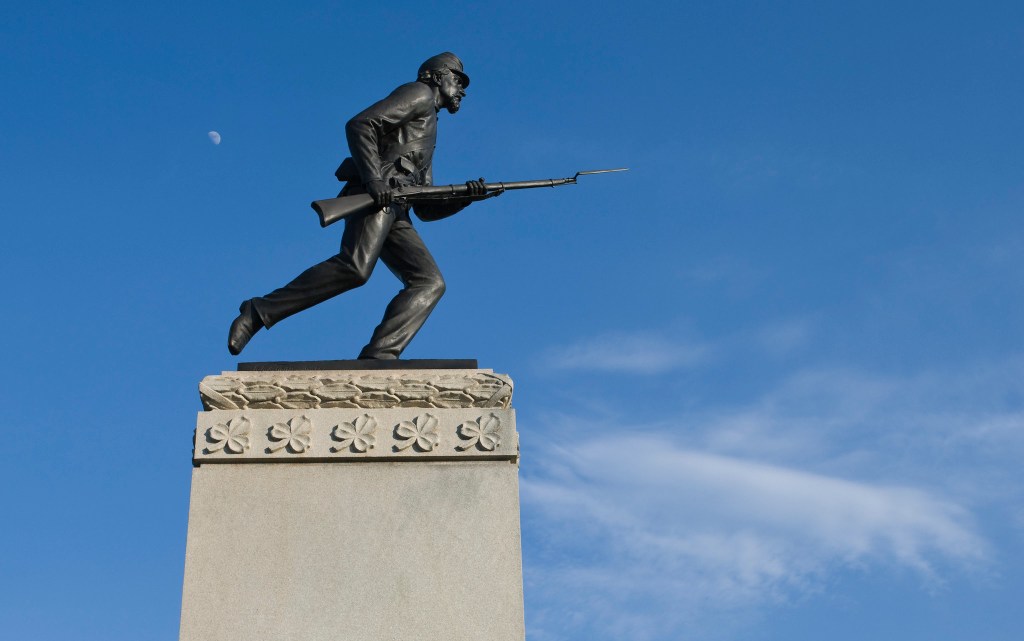
In the late summer of 1862, the armies of the Union and the Confederacy were converging on a little town in Maryland named Antietam. That battle would become the bloodiest single day in American history. There was a young Union soldier who fought in one of the skirmishes in the run-up to the battle. His name was Henry Struble. During the fight, Henry was injured and wound up in a field hospital. In an act of kindness, Henry gave his own canteen to the soldier lying next to him. Now in those days, soldiers didn’t carry identification or dog tags, but Henry’s name was on that canteen. As the fight went on, the other soldier went back to the battle with Henry’s canteen.
Time passed, and the war ended, and Henry Struble survived. A few years after the war, they opened the big national cemetery outside Antietam, and Henry went to pay his respects to the fallen with whom he had fought. Lo and behold, he stumbled upon a headstone inscribed with his own name. Shocked, his mind went back to the day, and he remembered that other soldier. That other soldier must have died with Henry’s canteen, and with no other identification, that other man was buried as Private Henry Struble. From then on, from 1867 until his own death in 1912, on every Memorial Day, Henry Struble would lay flowers at his own grave.
This little footnote to American history says so much. About the Civil War, about Memorial Day, about the horror of the battlefield. And I think of the other man’s family, the one who died as Henry Struble, that they probably never knew what happened to their brother, son, father, who was buried under an unfamiliar name. To them, he simply disappeared.
But it also makes me think about time. Stories like this compress past, present, and future into one solitary moment. Think of it. The living Henry Struble would go to his own grave on Memorial Day, the present moment. But that moment would be colored by the past, flooded with the memories of what had happened on that day at Antietam. And when Henry Struble laid flowers at his own grave, it was also about the future, his own future, when there would be another headstone with his name on it, and his body.
The Day of Pentecost, today, is one of those moments when the past, the present, and the future all come together at once, too. This is how we ought to hear the story of that first Pentecost. We read this story from the Acts of the Apostles every Pentecost, today, fifty days after Easter. Pentecost is a Jewish feast day, so there would have been pilgrims from all around the ancient Jewish world gathered in Jerusalem. The disciples are gathered together in prayer. When suddenly, this wind comes upon then, and tongues of fire, and they begin sharing the good news of Jesus Christ so that everybody from around the world could understand the message. And yes, we call this day the birthday of the church, maybe we snicker at Peter’s line about being drunk at nine in the morning. But it’s more than that. It’s past, present, and future all at once.
First, there is the past. Way back in the Bible, in the book of Genesis, at the Tower of Babel, the peoples of the earth were separated and scattered by their various languages. Then, there is the present, when “Parthians, Medes, Elamites, and residents of Mesopotamia, Judea and Cappadocia, Pontus and Asia, Phrygia and Pamphylia, Egypt and the parts of Libya belonging to Cyrene, and visitors from Rome, both Jews and proselytes, Cretans and Arabs” are all gathered in Jerusalem, and they all hear the same message. And the future. When the disciples speak in tongues so that everybody can hear the message of Jesus, it’s a glimpse of what God intends for the future. This is God’s downpayment. The future that God will make happen is when all people are one people, united by God alone. Pentecost is a sign of that future. The past, present, and future; all together at once.
This is the theological point I want to make. That for God, past, present, and future all come in one moment. God is outside of our time, God is fourth dimensional, and so God knows all the past, all the present, and all the future, all at once. God knows you – God knows your past, your present, and your tomorrow. This is good news.
One of the best examples of this, to me, is the confession of sin that we say every Sunday. We think of our past sins. We name them in the present moment. And we hope that God would help us become better people. Notice, we’re not praying that God would forget our sins, that God would forget our past. No. The grace of God is not that God forgets what we’ve done, the grace of God is that God remembers everything and God still forgives. And more than that, God has something in mind for us about the future. To move us through our sins, through our past mistakes, so that we would become holier, better people in the future. The past, present, and future all come together at once. This means that God knows you. God knows you better than yourself. You are not doomed to the past. Because God has a future for you. This is what the Holy Spirit does.
And I can attest – I have felt this Holy Spirit, I’ve had glimpses of this future. It is a blessing beyond words. In the times that I’ve prayed, when I’ve really felt close to the Holy Spirit, it did not come as a rushing, violent wind; I did not feel the Holy Spirit as a tongue of fire; I did not speak in other languages; I did not stand up like Peter and start preaching to the crowds. No, when the Holy Spirit has come upon me, I have felt a peace which surpasses all understanding. When I’ve felt the Spirit of God, it’s like I can breathe fully. I feel as if I belong to God. When I feel the Holy Spirit, it’s this immeasurable, deep joy. Not happiness that comes and goes, not the amusement of a quick joke – but something way down in my soul that helps me know that no matter how hard or weird life is, the loving God abides with me, and will abide with me more and more, even to my end.
I don’t want to press the point too hard, but when I’ve felt the Holy Spirit in my heart, it is a bit like sending flowers to your own grave. Like a Civil War veteran standing in a quiet cemetery, seeing the countless headstones all spread out before him, knowing that one day, he will join their company. Past, present, and future all collapse into this one moment. In those times of prayer I’ve had with the Spirit, I am fully known by God. I can see exactly where I’ve been, where I am now, and the Spirit gives me hope for whatever is next. This is the point of prayer. Not that we would tell God what to do, but rather prayer is simply presenting ourselves to God. It’s opening our hearts to the Holy Spirit, completely surrendering ourselves to God, and allowing God to know our past, abide in our present, and shape our future.
Pentecost, to me, is this incredibly sacred gift. On Pentecost, God comes to dwell in our hearts. On Pentecost, we are known fully to the loving God. On Pentecost, we present our whole lives to God to receive the blessing of peace which surpasses all understanding.

 The Rev. Jimmy Abbott
Leave a comment