
The Rev. Jimmy Abbott
The Sixteenth Sunday after Pentecost
September 17, 2023
Matthew 18:21-35
The video of this service is on the Trinity Episcopal Church YouTube channel. The audio version of the sermon is available on the Trinity website.
In my free time I enjoy reading ancient Greek mythology. Shocking I know. You might have hated reading all that stuff in high school. I loved it. Gods acting like frat boys. Love. War. Sea monsters. You want teenage boys to start reading books? Give them Homer.
But I was thinking of one particular story this week, one old myth. There was a handsome young man, they say, named Narcissus. He was the heart throb of all the girls, even the goddesses chased after him. But Narcissus, as you can guess by his name, was not so interested in any of them. Until one day yet another heartbroken girl prayed, “May he who loves not others love himself.” The gods they say, answered her prayer. And so it happened that Narcissus bent over a pool of water to drink, saw his own reflection, and was stunned by himself. Transfixed by his own appearance, Narcissus couldn’t turn away. And, they say, he stood there, peering at his own reflection, for the rest of his life.1
The ancient Greeks knew it, and we know it, too, that a life focused on ourselves is not much of a life. Not only does our egotism, our self-centeredness hurt the other people in our lives, it also hurts us. That’s such a tremendous insight, and such a paradox. The law of nature seems to say that we should care for ourselves, to survive and thrive. But it’s just not true.
Jesus picks up on the same theme. Notice how this gospel lesson started. Peter came and said to Jesus, “Lord, if another member of the church sins against me, how often should I forgive? As many as seven times?” (Matthew 18:21). This is the lesson of Narcissus. Peter assumes that he will be sinned against. Peter is only gazing at his own reflection. He can’t even countenance the idea that he could sin against someone else. We hear this kind of thing all the time. “If only they would do the right thing, vote the right way, act the right way; if only they would do things the way I would do them, then the world would be okay.” It turns out that we are Narcissus.
So Jesus goes on to tell Peter a parable of warning. A slave is indebted for a mountain of money, but manages to get his debt released. That same slave goes after another slave for some pocket change, but refuses to release that other slaves’ debt. It’s the same story. That slave begs for mercy, because he wants out of the jam. And then that same slave demands payment, because his only concern is for himself.
And notice, that the slaves’ infatuation with himself destroys everybody around him. The other slave is thrown into prison. The master gets irate to the point of torture. And that slave himself is punished for his selfishness. A whole web of relationships, a whole network is taken down by one man’s egotism. Self-centeredness, egotism is not just an irritating behavior. It’s destructive. One of the lessons here is that we live in an interconnected world, our lives are linked inextricably with other people. And when we are too wrapped up in ourselves, when we can’t look away from our own reflection, everyone around us suffers. That’s my theological point.
So let’s talk about the thing we’re all a little self-centered about, money. The thing that we love looking at. I want to talk about our annual pledge campaign, I want to talk about money here at Trinity Church.
First, there is no single donor, family, endowment, or foundation that sustains our budget. In fact, only 16% of our annual budget comes from the Trinity Church endowment. This church is funded by the money that you give, it comes from your generosity.
Second, consider what this budget does, what the money you give does. I’m not taking about repairs to this building. Our annual budget is about upkeep and ministry. The money we give on a regular basis pays for, say, the electric bill. And y’all, you would be horrified at how big that number is for a place like this. It pays for insurance. It pays for the staff. It pays for the oil in the candles, the wine at communion, and the coffee and donuts afterwards. It pays for kids to have Goldfish during Sunday School. It pays for youth ministers and children’s chapel. You make that happen. It pays for the doors of this place to be opened, week by week. And more than that, the money you give goes beyond these walls. We support the Galveston Diaper Bank, the Ronald McDonald House, St. Vincent’s House.
What I am saying, is that the church budget may not, in fact, do a whole lot for you personally. And in that, we are learning the key theological point. We give, not for ourselves, but for someone else. By giving, we learn the lesson that Jesus is teaching Peter. It’s not about us. Without your gifts, without the money you give, other peoples’ lives would be worse off.
The theme for this year’s pledge campaign is “Digging Deeper.” Digging deeper so that other people can enjoy this. Not digging deeper because we want a bigger budget, or more people – but digging deeper so that we grow in our faith in Jesus.
And, I want to be transparent with you. I do not ask you to give without my family first considering our gift. This year, Maggie and I are choosing to dig deeper, and we in 2024 we will increase our pledge to the church by 10%. I am not saying that you have to do the same. I am not using this to coerce you. Whether you give more, less, the same, or none at all – you are a beloved child of God. This is not a sales pitch. And I realize full well that every single person in this room has their own financial realities. I know the stress of inflation – I see it both at home and in the church budget. But, as your priest, I want you to know that I am putting my money where my mouth is; I am putting my money where our heart is. At Trinity Church. And I know, I know how much I love my own money. I know the temptation of Narcissus, to stare at my own money, transfixed by it. I know the temptation of Peter, to think that the church is all about me. This pledge campaign is about none of that. This is about how I want to dig deeper and follow Jesus.
And that’s where I want to end today. Digging deeper. It’s one of the great stories of Trinity Church, really. In 1925, they came up with a scheme to protect this old place against hurricanes and flooding. Quite literally, they dug deeper underneath the church. And under this entire building, they installed these giant screw jacks. And at the beat of a drum, all the workers would turn their jack at the same time so that the building was lifted up evenly. The pictures of this work, the picture you’ll see on your pledge campaign brochure, to me, are terrifying. Can you imagine being down there with the church on top of you? And yet, because they dug deeper, this whole place was lifted up. We are the beneficiaries of their work. They dug deeper so we could go higher. They gave and worked not for their own benefit, but so that you and I could be here today. We will do the same. Considering not what our gifts do for us, but considering what our gifts do for the greater good.
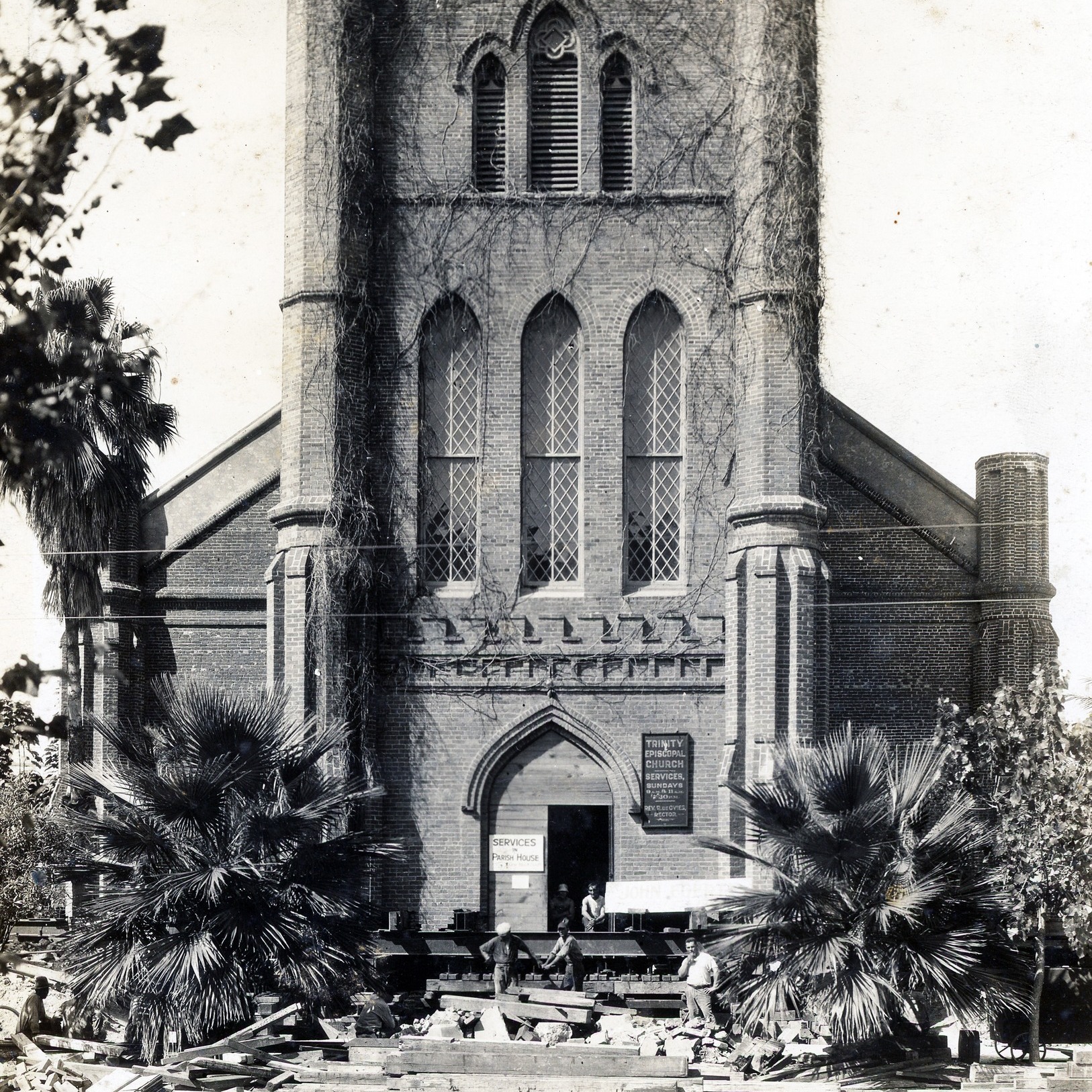
Today, I am asking you to consider how you can dig deeper – not just with your money but with your whole self – not only for the good of the church, but for the good of your own soul. A life that is lived for others is not only better for them, it’s better for you. Pull yourself away from your own reflection, and dig deeper with Jesus.
- Hamilton, Edith. Mythology: Timeless Tales of Gods and Heroes. 75th anniversary illustrated edition. New York: Black Dog & Leventhal Publishers, 2017, 92.
↩︎


 The Rev. Jimmy Abbott
Leave a comment