The Rev. Jimmy Abbott
Seventeenth Sunday after Pentecost
September 24, 2023
Matthew 20:1-16
The video of this service can be found on the Trinity Episcopal Church YouTube channel. The audio is available as a podcast here.
“When God saw what the people of Nineveh did, how they turned from their evil ways, God changed his mind about the calamity that he had said he would bring upon them; and he did not do it” (Jonah 3:10).
Last week, I went to visit Birmingham, Montgomery, and Selma, Alabama. I went with a group of Episcopalians from across Texas to see the iconic sites from the Civil Rights movement: the 16th Street Baptist Church where the little girls were murdered during their Sunday School, where Rosa Parks got on the bus for her historic ride, the Edmund Pettus bridge from Bloody Sunday.
I know that some of you remember watching these things on TV. You heard your parents talking about it at the dinner table. I saw the pictures in my textbooks and read the speeches. And I was a young boy in Los Angeles, watching the Rodney King riots in 1992. These things lives in our national consciousness.
But one place in particular got to me this week. On this hill in Montgomery, Alabama, they have installed hundreds of big, rectangular metal columns, one for each county or parish in America where there was a lynching from 1877 to 1950. Surrounded by these, you start at the top of the hill and then weave your way down, reading the names on the columns as you go by. Counties in Alabama and Mississippi, yes, but also Minnesota, California, Delaware. And then, at the very bottom of the monument, you look right up above you and you see this column, hanging above you. Galveston County, Texas.
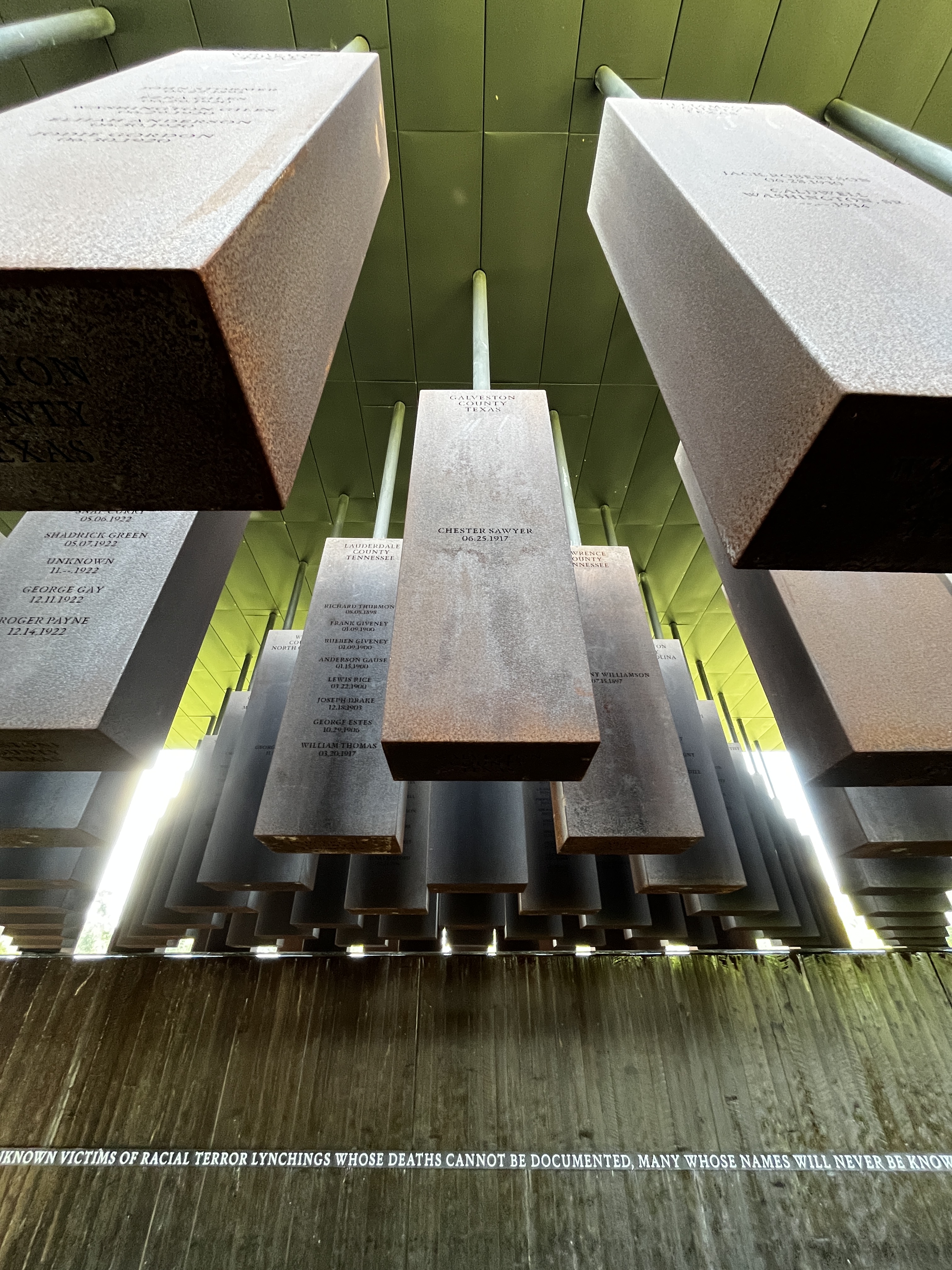
Chester Sawyer was a black man who had been arrested and placed in the Galveston jail. In the evil, midnight hours of June 25, 1917 a mob of armed white men broke into the jail, tied up the prison guards, took Chester Sawyer. The newspaper account even says that the phone lines from the jail were cut, so that the prison guards wouldn’t be able to call out and ask the sheriff for help. They took Chester Sawyer to what was then the outskirts of town, and killed him. And left his body hanging by what is now the corner of 61st Street and Stewart Road.1
61st Street and Stewart Road. Like, by the Panda Express. How many times have I driven through that intersection? How many times have I waited there, impatiently? How many times have I tried to squeeze through that yellow light, trying to get to my tee time at Moody Gardens? How many times have I sat there and watched the pelicans soaring above me, peacefully removed from our human madness? Even if we roll up the windows, turn up the radio, turn down the A/C and try to “just move past it,” we can’t. Even if do not want to be close to it, it remains close to us.
Our passage from Jonah says, “When God saw what the people of Nineveh did, how they turned from their evil ways, God changed his mind about the calamity that he had said he would bring upon them; and he did not do it” (Jonah 3:10). Remember, Jonah was a man called by God to go to the city of Nineveh to tell them to stop sinning. Jonah, overwhelmed by this call, tries to sail away on a ship, gets thrown overboard, swallowed by a whale, and then spewed upon the shores of Nineveh. Listen y’all. When God has is determined to do something, God will use whatever it takes to make it happen. And then Jonah goes to the city of Nineveh and tells them all to stop sinning. And much to Jonah’s surprise, they do. The people repent.
We read this story and all too often, we put ourselves in the place of Jonah. We think that we are the ones called by God to go out and tell everyone to do the right thing. When things don’t work out for us, we think that we are the belly of the whale. We think that we are just that special because our mother told us we are just that special. But after this week, I’m again reminded that, in fact, we are the people of Nineveh. Not just this city, but as a whole, we are a people with evil ways. What happened at the corner of 61st Street and Stewart Road stands as a testament to it.
So for me, after seeing all of that this week, after reading these newspaper accounts, after reading again the horrors of slavery, lynching, Jim Crow, and mass incarceration, I’m reminded that it is all begins and ends with the human heart. We look in the collective mirror and see, indeed, that we have the capacity to perpetrate great evil on a massive scale.
But I also know that humans can change. The other truth I saw this week, the other truth I read in Jonah, is that people can repent, turn around, do a new thing. Evil does not have to win. The people of Nineveh do, in fact, confess their sins and live differently. Even then, in 1917, a newspaper editorial had this to say: “The Galveston mob has brought disgrace to the city of Galveston, has inflicted a blot upon the name of the State and shamed the constitution and the laws by which we strive to maintain our civilization.”2 The correlation with Jonah and Nineveh is too obvious to pass on. Yes, God is angry with the people of Nineveh, but God can also delight in the people of Nineveh when they repent. To change the system, to move forward from this checkered past, there is but one place to begin. The human heart.
So what does this mean for us, for the people of Trinity Church? I know that you and I were not there at 61st Street and Stewart Road in 1917, I know that things are different now. For me, it’s about honestly acknowledging what happened in the past, repenting, and living in a new way. We can acknowledge, for instance that Saint Augustine of Hippo Episcopal Church, the oldest historically black Episcopal church in Texas, just twenty blocks from here, has historically not had access to the resources that Trinity has had. But we can live in a new way. It is a good thing, I believe, that we now have Bible Studies together with that congregation. We worship together on holy days. We do Lent together. And in quiet ways, we have supported Saint Augustine of Hippo financially. This is not about assuaging white guilt or about being a white savior. It’s not some new thing I got real excited about on a church trip. No. This is about loving our neighbors as ourselves. It’s about the people of Nineveh who actually listened to Jonah and did a new thing. “When God saw what the people of Nineveh did, how they turned from their evil ways, God changed his mind about the calamity that he had said he would bring upon them; and he did not do it” (Jonah 3:10).
Even in the middle of a pledge campaign, like we are now, we need to hear this lesson. God delights in our repentance, in turning around, in digging deeper, in giving back, and in loving our neighbors as ourselves. I am so pleased that when I give, when I pledge to Trinity Church, I know that it helps more than ourselves.
And I know that this is probably not the sermon being preached at churches across Galveston this morning. I know that it’s not a feel-good story. I know there are children in the room, but I think they need to know these things, too. I know that I haven’t asked you to accept God in your hearts, but in a way I have. I haven’t told you to live your best life, but maybe I did. And I know, that most of you do not come to church on Sunday morning thinking about civil rights, or wrestling with issues of race and poverty and justice. You came here today to give thanks, to see friends; you came here because you are going through a hard time, to pray for your sick friend; you came here because you want to grow closer to God, because it’s just what you do on a Sunday morning. And yet, the message is all the same. It’s about the human heart. To give thanks when blessings have been received and to make changes when sins have been committed.
One last thing. This whole story calls to mind another story of another man who died on the outskirts of town under the cruel oppression of a foreign empire. The Lord Jesus. On the cross. The cross is at once a reminder of shameful torture and execution, and it is our glory, our hope that things can change. You put that cross around your neck, you look at the cross on the altar, as both a reminder and for courage. The next time you drive through 61st Street and Stewart Road, maybe even on your way home from church today, I pray for the same effect. To remember that outrage, to mourn that death, to not allow its memory to fade or to be swept under the rug. But also to draw courage for the future. To live differently. To dig deeper. To live better. To love.
“When God saw what the people of Nineveh did, how they turned from their evil ways, God changed his mind about the calamity that he had said he would bring upon them; and he did not do it” (Jonah 3:10).



 The Rev. Jimmy Abbott
Leave a comment