
The Rev. Jimmy Abbott
Nineteenth Sunday after Pentecost
October 4, 2023
Philippians 3:4b-14
The audio of this sermon is available as a podcast. The full vide of the service is available on the Trinity Episcopal Church YouTube channel.
Dedication. Resilience. Fortitude. The qualities we admire, and desire, in our leaders. Think of that great American heroes – George Washington, freezing at Valley Forge but sticking with it. Rosa Parks, deciding that to sit and stay put was best of all. Dedication. Resilience. Fortitude. These are the people we respect and admire.
Because we despise anything else. Quitters, wimps, or the worst insult in today’s modern political environment, flip-flopping. That’s the worst criticism we dish out. Somebody is a flip-flopper. They said one thing, and then heaven forbid, they changed their mind. We’ve gotten to this place where we reward people who are rigid, unyielding, single-minded.
But, that can’t be everything, can it? Because our heroes are also people who, gasp, changed their minds. Think of them. At first, Abraham Lincoln would have kept slavery intact if it would have saved the Union. Then he changed his mind. Or on the personal level, and nothing as drastic, I know many of you have changed your minds on all sorts of issues. You thought one thing, learned something new, and then came away with a different belief. This is a good thing.
The same with Saint Paul. In his letter to the Philippians, he lays out his rigid, unyielding, single-minded credentials. “If anyone else has reason to be confident in the flesh, I have more: circumcised on the eighth day, a member of the people of Israel, of the tribe of Benjamin, a Hebrew born of Hebrews; as to the law, a Pharisee; as to zeal, a persecutor of the church; as to righteousness under the law, blameless” (Philippians 3:4b-6). Paul is the real deal.
And yet, that is not why we remember him. That is not why it seems that every other church in the world is named after him. We remember Paul not because he was rigid, unyielding, and single-minded. No, we remember him because he changed his mind.
Paul goes on to say, “Yet whatever gains I had, these I have come to regard as loss because of Christ. More than that, I regard everything as loss because of the surpassing value of knowing Christ Jesus my Lord” (Philippians 3:7-8a). You know the story. Saul, as he was known then, had permission to go root out and arrest followers of Jesus. He was traveling from Jerusalem to Damascus when suddenly, that same Lord Jesus is revealed to him, knocking him down, physically and spiritually. And because of that he changed his mind. He changed his life. He started over again. He even changes his name, to Paul, to signify his new way of life. And that’s what counted.
This is deep in our Christian life. We do not celebrate the people who are rigid, unyielding, single-minded. No, in fact, those are usually the villains of holy scriptures. We celebrate the people who change their minds. Time and again, the prophets are calling the people of God to return to God, to change their ways. John the Baptist is telling the people to prepare themselves, to open their hearts and prepare for the Lamb of God. Jesus himself begins his ministry by saying, “repent, for the kingdom of heaven is at hand.” Repent. Turn around. Do something different. Change your mind. That is why we are here today. Not because we are members of a rigid, unyielding, single-minded religious sect. No, we are here because at some point in our lives, we have repented, turned around, changed our minds, and followed Jesus.
Again, to our modern world, this looks like weakness. How many times now have we seen our leaders dig in their heels, entrench themselves on one side or the other? Refusing to think beyond themselves? For the Christian, that is not strength, or power, or righteousness. No, for the Christian, a closed mind is usually a sign of weakness. It shows that we haven’t been curious enough about the world around us. It might even show that we are insecure, too spiritually immature to consider the freedom of God. A wise old priest once told me that doubt is not the opposite of faith. No, fear is the opposite of faith. Fear is the opposite of faith. Fear of acknowledging that you were once wrong. Fear of changing your mind. Fear of looking like a flip-flopper.
And more than that, we learn from the scriptures the way to open our minds. The first step is humility. Humility. Every Sunday, we fall to our knees and confess the wrongs we have done and the rights we have left undone. This is humility. Or think again of Saint Paul. He was struck down by God, literally knocked down by the grace Jesus. He was humbled. And remember, he is writing this letter to the Philippians while he is in prison. Talk about humility. He is locked up in some dingy ancient prison; probably cold, hungry, and alone. But it’s that posture of humility that opens his mind to consider his position. So while his body might be locked up, his spirit is free. He can look at his old life, and embrace his new one, even in chains.
Humility. Perhaps that’s the virtue most absent in our world today. The capacity to acknowledge that we might be wrong, that something else might be right, that we might not have all the answers. You’ve seen it as well as I have – friends of ours getting into yelling matches in the comments on Facebook, trying to prove someone else wrong. Letters to the editor in the paper, with two sides going at it, calling each other names. It’s gotten to be too much. Like Paul who so doggedly persecuted the church of Jesus, all too often we are so committed to our side, that we don’t even care about right or wrong anymore, we just care about winning.
It doesn’t have to be like this. There is another way.
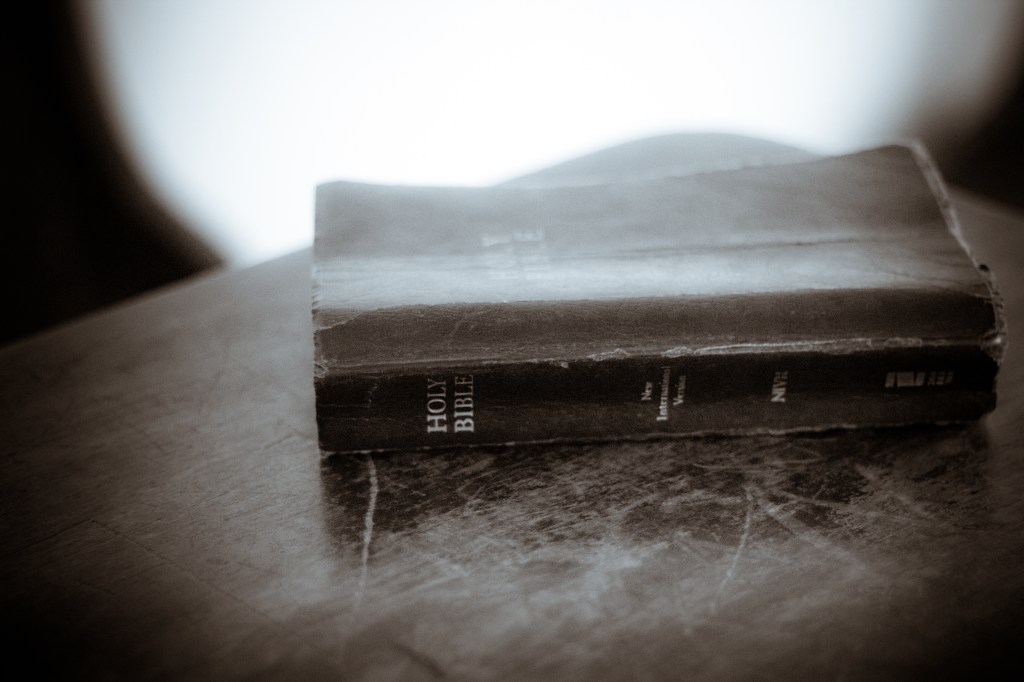
And we see it right here in church today. One year ago, Trinity Church received our set of the Saint John’s Bible. You know, it’s stunning. The artwork is amazing, the calligraphy is unreal. But my favorite parts of it, are the mistakes. Where the calligrapher accidentally left out a line of the text. Rather than erasing it, or starting over, or trying to cover up their error, they had fun with them. On one mistake page, they corrected it with a ring-tail lemur, pointing to the spot where the missing words should go. On another, there is a bumble bee. As one artist said, “if you make a mistake, don’t fix it, feature it.”
Don’t fix it, feature it. And so that’s precisely what we learn from Saint Paul today. “…whatever gains I had, these I have come to regard as loss because of Christ. More than that, I regard everything as loss because of the surpassing value of knowing Christ Jesus my Lord.” Don’t be afraid of having an open mind, rejoice in it. Don’t be worried about looking like a flip-flopper, but more worried about knowing the truth. Do not dig in your heels, we don’t celebrate the rigid, unyielding, single-minded. We celebrate those who changed. Don’t be afraid of ending up on the wrong side in this world, because most of all, it’s about being on God’s side.
And so I end today with Paul’s words, the words of humility, the words of an open mind. “Forgetting what lies behind and straining forward to what lies ahead, I press on toward the goal for the prize of the heavenly call of God in Christ Jesus” (Philippians 3:13b-14).
Bibliography
Bloomquist, L Gregory. “Subverted by Joy: Suffering and Joy in Paul’s Letter to the Philippians.” Interpretation 61, no. 3 (January 1, 2007): 270–82.
Grant, Adam. Think Again: The Power of Knowing What You Don’t Know. New York, New York: Viking, 2021.



 The Rev. Jimmy Abbott
Leave a comment