All Saints’ Sunday
November 5, 2023
Revelation 7:9-17
The audio of this sermon can be found on the podcast page. The full video of the service can be found on the Trinity YouTube Channel.
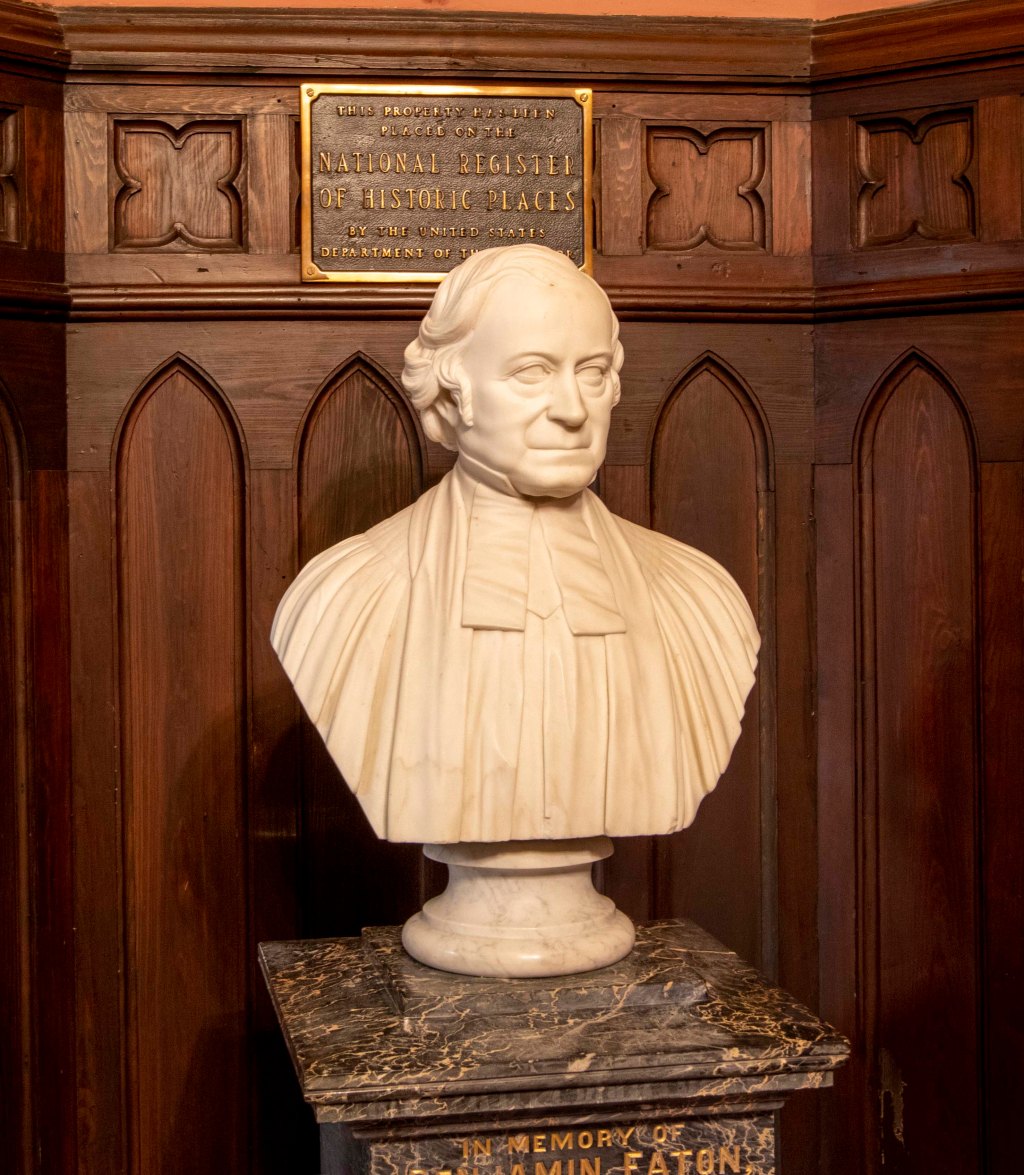
Of all the great stories of Trinity Church, it is the greatest. You might know it. Sunday, March 19, 1871. The Rev. Benjamin Eaton, the first priest of Trinity Church is standing here, where I stand now. He begins to preach, when his voice falters. The newspaper account put it this way: “He painted death entering the church door, passing up the broad aisle, laying his bony hand to the right and to the left; breathing his cold, clammy breath on the cheek of beauty, and wafting the silver hairs of old age.” The old rector, raises his hand in a final blessing, “to God the Father,” and then collapses and dies. “If ever terror is beautiful, it was beautiful then.” Truly, the greatest of all the stories.
And still today, we honor Mr. Eaton’s memory. He is buried, just over there, under the altar. Eaton Memorial Chapel, now Eaton Hall, was built in his memory. His bust greets you as you enter the church doors. For as long as there will be a Trinity Church, Mr. Eaton’s death will not be forgotten.
But I’ve been thinking about him lately, as I do around All Saints’ Day. And I realized once again, that we don’t honor him because of the way he died. Any old priest can die in a pulpit. No, we honor and remember Mr. Eaton for the way he lived. Sent as a foreign missionary from the Episcopal Church – he traveled for thousands of miles, across vast bodies of water, braving the freezing cold, arriving at that far distant country, Galveston, and started Trinity Church. During the yellow fever epidemics, he borrowed a horse and buggy to go tend to his sick and dying parishioners. They say he sought to build up the church, not by proselytizing, but by gently caring for and teaching the children of the city. All the way from Galveston, he helped run both the University of the South in Tennessee and the General Theological Seminary in New York. He was in second-in-command of the Diocese of Texas for twenty-two years. I held that position for one year and it about did me in. They say in all his years of preaching, never did he have an inattentive congregation, never did he get into bewildering theological questions; but only focused on how to live in Christian love. Mr. Eaton’s death was memorable, certainly, but that is not why his memory is dear to us. We honor his legacy because of how he lived.1
This is what that glorious reading from Revelation is trying to say. A man named John has a vision, and he looks, “and there was a great multitude that no one could count, from every nation, from all tribes and peoples and languages, standing before the throne and before the Lamb, robed in white, with palm branches in their hands” (Revelation 7:9). They are gathered around Jesus, and yet John does not know who they are. One of the elders, who is also worshiping Jesus around the heavenly throne asks John a rhetorical question, “Who are these, robed in white, and where have they come from?” I said to him, “Sir, you are the one that knows.” Then he said to me, “These are they who have come out of the great ordeal; they have washed their robes and made them white in the blood of the Lamb.” (Revelation 7:X).
These are they who have come out of the great ordeal. The great ordeal. What a way to describe the Christian life. The great ordeal. These are the countless generations of Christians who have lived faithful and charitable lives, who have committed themselves to the life of Christ. They have given and worked and prayed and followed Jesus. Gathered in that vast multitude around the throne of Christ, John sees the poor in spirit, those who mourn, the meek, those who hunger and thirst for righteousness; John sees the merciful, the pure in heart, the peacemakers. In times of persecution, they were steadfast. In times of hardship, they preserved. (Matthew 5:1-12). Though we do not know their names, or where and when they died; we know the most important thing. They lived for Jesus.
This is our call. Most of us, we will not be remembered either for our lives or our deaths. Certainly, a few generations of our family and friends will cherish our names, but eventually even those memories will pass on. The vast majority of us will fade into unidentified anonymity. Even if we spend our whole lives building kingdoms, wealth, notoriety, fame; that is no guarantee. Percy Shelley wrote a poem about this, “Ozymandias.” The poem describes a broken statue in the middle of a desert, and all that remains of the statue are two vast and trunkless legs of stone. On the pedestal of that once great statue, the inscription reads: “My name is Ozymandias, King of Kings; Look on my Works, ye Mighty, and despair!” But nothing else remains, “boundless and bare the lone and level sands stretch far away.”2 Even the mightiest among us will fade away from earthly memory. We will be forgotten.
But Jesus will remember. This is the good news of All Saints’ Day and All Souls’ Day. We are not forgotten. Regardless of our relative fame or anonymity here on earth, we will all be known by God equally in the heavenly country. And those whom we love but see no longer; the names that we will read aloud today. Our friends, our mothers and fathers, our husbands and wives, our brothers and sisters, or children who have died – they are not forgotten either. Jesus remembers them. And the promise of Revelation is that when we weep, God will dry out tears. Even if nothing is named after us, even if we don’t have priests telling stories about us hundreds of years from now, even after each and every one of us is long gone, the Lord God Almighty will remember who we are. For the great promise is that we will all be standing around the throne of Christ, and John will look at us, and there we will be, robed in white with palm branches in our hands, worshiping the Lord God day and night with all the saints who have gone before. God will not forget us.
This is my own hope. I don’t live and work here, hoping to one day have a statue, or a building named for me. I won’t be buried down there. Because that’s not the point. The point is that Jesus has liberated from me my own human desire to be known. We can stop the rat race, the desperation to be known. Because we are already known and loved by God. This is freedom, this means that we can go about our lives, free to love, free to give mercy and grace and compassion. Because we’re not so worried about how we are remembered, but we are only concerned about how we live. We live for Jesus. We live for each other.
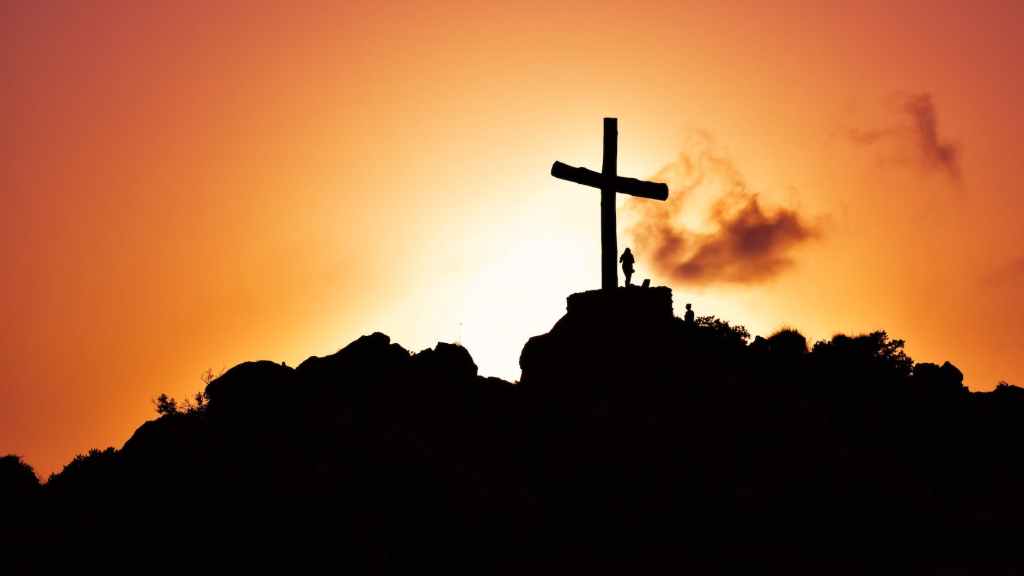
This, I think, is what old Mr. Eaton would say to us. I don’t think he would care about statues and crypts and legacies. No, I think he would want us to do what he spent his life doing. Loving one another, teaching our children, caring for the sick, building up the church. We will honor his legacy, we will honor all the saints, not by remembering them but by remembering the words of our Lord Jesus Christ – to take up the cross and follow him.
- History of Trinity Episcopal Church, Morgan. ↩︎
- Foundation, Poetry. “Ozymandias by Percy Bysshe Shelley.” Text/html. Poetry Foundation. Poetry Foundation, October 29, 2023. https://www.poetryfoundation.org/. https://www.poetryfoundation.org/poems/46565/ozymandias.
↩︎

 The Rev. Jimmy Abbott
Leave a comment