The Sixth Sunday after Pentecost
June 30, 2024
Mark 5:21-43
You can listen to this sermon here.
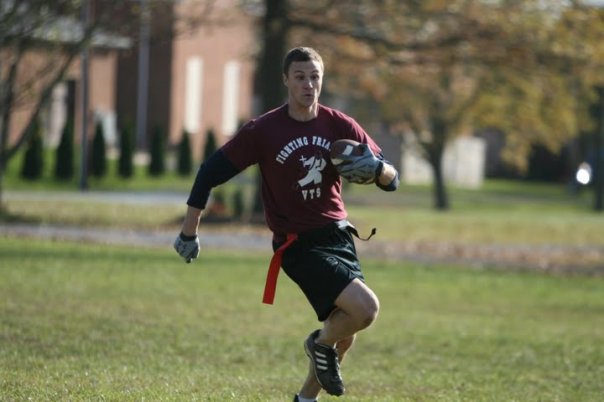
I reached the pinnacle of my athletic achievements while playing seminary flag football. And yes, seminary flag football is a big deal. After you spend all day conjugating Greek verbs and studying systematic theology, you really, really want to hit someone. Now my seminary was the Virginia Theological Seminary, also known as the Fighting Friars. Our biggest rival was the General Theological Seminary in New York. Both part of the Episcopal Church. Isn’t it funny, your biggest rival is always the person who is the most like you?
Yours truly was starting wide receiver. One other quick thing about that – in college, I played tuba in the marching band. In seminary, I was the starting wide receiver. I did not change, it’s just the people around me had definitely changed. So there we were, the big game against our fiercest rival and the first kickoff came straight to me. Like the parting of the Red Seas, my blockers made a path and I ran that kickoff back for a touchdown. And I am so proud to say that we beat General Seminary like a drum. My proudest athletic achievement.
But it’s a funny thing, you know. After the back slapping and the trophy ceremony and the fruits of victory, well, life went back to normal. The next day we all went back to work at church, we went back to class. Everything returned to normal. It’s a funny thing, I watch sports now, say the Olympics, and I see how much it means to win a gold medal. And then I wonder – what happens the day after? Isn’t it all a bit of a letdown? You’ve worked your whole life for this, you’ve had this moment, you’ve won the gold medal, you are the absolute best in the world at what you do; what happens next?
I’ve also felt this spiritually. I’ve had those mountaintop moments, when I felt close to God and God felt close to me. Like when I was ordained to the priesthood. It was an amazing day, when everything just clicked. I was surrounded by family and friends and I felt the Spirit of the Living God in my heart of hearts. The hardest part, though, was waking up the next day. When life just went back to normal. I still had to do the dishes, deal with traffic, go to the grocery store. There’s always, always a letdown.
That’s what I can help but think about when I read these stories from the gospel. This father, this desperate man falls at the feet of Jesus begging Jesus to do something for his daughter. A woman, after hemorrhaging for eighteen long years, slips in behind Jesus in the crowd to touch his cloak, in hopes that she might be made well. And what happens? They all have the most amazing day of their entire lives. The little girl is raised from the dead. The woman is restored to health. This is as good as it gets. No day will ever top this. They have all experienced God in ways you and I could never imagine.
And yet I wonder – what happens after that? I mean, this little girl was twelve. I know twelve year old girls, the next morning she’s going to wake up, want breakfast, have to do her chores, go back to life. How mundane. Her life was changed, surely. But did it really change that much? And I wonder, too, about that woman. An amazing gift of grace and love, to be healed. What a day, a miraculous day, a day her life changed. But I wonder – what happened the next day? Or the day after that? Next week? Next month? The Righteous Brothers sang it all too well – “you’ve lost that love and feeling.”
See, that’s the question that this gospel lesson poses to us. The story does not go on to describe what that little girl did when she grew up; whether she went on to be a petulant teenager or some sort of spiritual hero. The story does not go on to say what that woman did with the next eighteen years of her life. I think the stories are intentionally ambiguous, open-ended so that we can put ourselves into those places. We shouldn’t come to these stories and ask the boring questions – what kind of sickness did the little girl have? Why was this woman ill for so long? Does Jesus has some sort of magical powers? No, no, no. This story is asking questions of us.
What are we going to do with our lives after we have met Jesus? That’s the question. So often, Christianity gets all wrapped up into making sure that you meet Jesus. I mean, strangers will even knock on your door and ask you if you’ve found Jesus. That’s the wrong question. And it’s always fun to respond, “found Jesus? You mean, he’s lost?” And we all know plenty of places in Christianity where it’s all about emotion. Going from one spiritual fix to the next. Going from this retreat to that pilgrimage to that concert, always looking to get that feeling. And how many of us don’t feel anything in this life with God, so we think that somehow God is distant. Just because we aren’t feeling it, just because we aren’t raising the trophies, and having moments of clarity, and hearing to God talk to us, we could think that something is wrong; that we’re not connected with God. Because that’s going about it all backwards.
Instead, we should all just assume that the Lord God has already moved in our lives. In one way or another, the Spirit of God has done something for you. Like the little girl, like the woman in this story, the Lord Jesus has been in our lives. By virtue of our baptism, just by being human, God has done something in you and for you.
So the real question of the Christian life is “what do you do when you’re not feeling it.” Like the Olympian who’s just won a gold medal, like a young girl just raised from the dead, and like a woman given new life – what do we do on all the days that aren’t our best days?
And the answer, my goodness, it’s so mundane. And that’s what makes the Christian life sometimes so unappealing. We come to church. We read our Bibles. We say our prayers. We volunteer. We give. And more often than not, we won’t get big spiritual rush from any of that. And I want to say that that is okay. Because the real heart of the Christian faith is in not in your big religious experience; the heart of the Christian faith is going about your faith, day by day, sometimes in the most mundane ways, whether you feel it or not.
So take a moment to imagine, imagine that little girl growing up, dutifully going about her life, in quiet gratitude that she’s been given a second chance at life. Imagine that woman, in constant thanks for what Jesus did for her. Imagine all those seminarians, both the winners and the losers, now all priests in the Episcopal Church this very morning, standing at their own altars, and praying for their people. It doesn’t have to be flashy; it doesn’t have to be emotional. More often than not, it won’t be. That’s what happens week by week when we gather at this table. It’s not a big meal, it’s not anything extraordinary really. And it’s okay if you don’t feel something every time. Because whether we feel anything or not, God has feelings for us – feelings of love, grace, and mercy.
So in the midst of all the noise and commotion of this gospel lesson – the begging father, the jostling of the crowd, the weeping and wailing – there is a quiet dignity, I think. The quiet dignity of the Christian life. There is dignity to approaching this altar, week by week, to give quiet thanks for what God has done in your life. There is dignity to the silent prayer, the obedience to worship, the simple joy of thanking God. God has already moved in your life, that is for certain. Maybe in a big way, or maybe in a million little ways. Thank God for that. The real question, the question of the rest of your life – is what are you going to do about it now?


 The Rev. Jimmy Abbott
Leave a comment