
Christ the King Sunday
November 24, 2024
John 18:33-37
Two truths and a lie. It’s one of those silly icebreaker, get to know you games. I’ll start. I’ll tell you three things about myself, two are true, one is a lie. And you’ve got figure which is which. 1. I was homecoming king of my high school. 2. I grew up Presbyterian. 3. I learned how to play saxophone in college. Which one is a lie – well, I’m going to leave you hanging.
Because, who knows the truth? Truth. It’s up for grabs nowadays. Because no matter what the discussion is, you can find just about anything on the internet, you can find anything to back you up, to prove your truth. Now, before we wring our hands and get into that old trope about how bad the state of the world is today, let’s look at the scriptures. Because we’ll see that the truth has always been up for grabs. This is not a new phenomenon, it’s as old as humanity itself.
How can we know the truth? Who can we trust is telling us the truth? Or, in the chilling words of Pontius Pilate – “what is truth?” (John 8:38). This is important stuff, because the search for truth is about discerning the will of God, about our purpose in the world, and about who we follow. Truth.
So this morning we read from the Gospel of John. It’s towards the end of Jesus’ life; in fact, it’s the morning of the day on which Jesus is crucified. Here’s the scene. Jesus has been causing problems for the leaders in Jerusalem. He’s been teaching and preaching about the kingdom of God and about God’s grace. Jesus has been healing people, he’s been disrupting the status quo. Jesus has even dared to raise a man from the dead. Simply put – this will not do. So the leaders in Jerusalem conspire against Jesus, they conjure up some charges against him, and present Jesus to Pontius Pilate. Pilate is the Roman governor in the area. He’s the one that has the military power, the real political authority. All the leaders in Jerusalem know this – that even though Jerusalem was a Jewish city, the Romans are in charge. Pilate is the one who can call upon the Roman legions. Pilate is the one who is supposed to keep the city occupied with Roman soldiers. Pilate is the one with the power to release, and the power to crucify.
And it’s before Pilate that Jesus says the words that will get him killed. Jesus says, “My kingdom is not from this world” (18:36). This is treason. Jesus is making a bold claim – he’s a king. Jesus is Lord, and the Emperor is not. I hope you see it. This is dangerous, seditious talk.
Because Pontius Pilate wants to keep the Emperor in Rome happy. Pilate doesn’t want the Emperor to get wind of other people calling themselves kings. Because if that’s what the Emperor hears, well, then, Pilate will be the who is punished. It’s a truism about empires – you have to make the people above you happy because you don’t want to imagine what happens if you don’t. So, wanting to please his boss, wanting to keep the “peace,” Pilate makes his decision. Jesus will just have to be crucified.
You can hear the disdain in Pilate’s voice. With a sneer, he says to Jesus, “So you are a king?” (18:37). Again, imagine this scene. Here is Pilate, at his beckon call is a legion of Roman troops with their spears and swords. Here is Pilate, a representative of the most powerful man on earth. And here is Jesus. A carpenter from *scoffs* Nazareth. Here is Jesus, who’s been beat up by his accusers. Here is Jesus, who can barely scrape together twelve guys to follow him because at the first sign of danger, most of them have run away. The disparity could not be clearer. “So you are a king?”
But Jesus makes a subtle move here. He doesn’t have to get into an argument about who is a king and who isn’t a king. No, Jesus makes the claim to the truth. “For this I was born, and for this I came into the world, to testify to the truth. Everyone who belongs to the truth listens to my voice” (18:37). See, that’s what makes Jesus a king. That’s what makes him worth following. Not because he’s been given a divine right or because he commands an empire or because he can summon an army. No, what makes Jesus worth following is that his only commitment, is to the truth. And that’s when Pilate responds, “what is truth?”
Again, the disparity could not be clearer. You have the full weight of the Roman Empire with all the trappings of power – with an army, a navy, with soldiers and senators and a vast empire – and they could care less about the truth. They just want power. And here you have a Jewish carpenter from Nazareth, and his little motley crew of followers, and the only thing that matters to them is the truth.
And so, the question is turned to us. What is truth? Between those two options – who do you say has the truth? Here they are – Pilate or Jesus. Disdain or humility. Violence or grace. Pilate tries bullies Jesus for his own self-preservation; Jesus speaks the truth though it will cost him everything. One man has the power to crucify and one man is willing to lay down his life. Which one is your king?
Not only is it a question of allegiance, it’s a question about the truth, and about how we know the truth. This is not a mildly interesting philosophical debate, the health of our souls depends upon this. This lesson is teaching us to discern the truth not by what sounds best, or by what is easiest to go along with, but by thinking about who is saying it and why. Pilate is a craven, ruthless, puppet of the Roman Emperor – and that reveals to us that he does not have the truth. Jesus is gracious and loving and is working for a better world – and that reveals to us that he does have the truth.
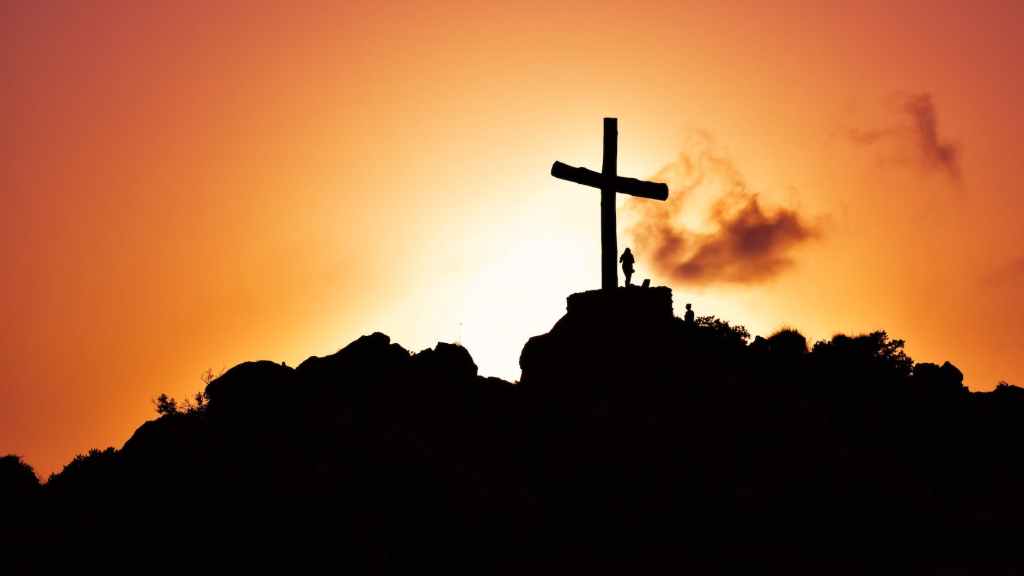
That matters, because then we can trust the other things that Jesus says. We know that Jesus is speaking the truth. About loving God and our neighbor. About removing the log from our own eyes before removing the speck from someone else’s. About turning the other cheek. About living in a community that cares for each other. About picking up our cross, even if it means our own crucifixion. We believe these things to be true, not because they are necessarily attractive, not because we are going to get ahead in life by doing them, but because of who said them. The true king of the world, Jesus. Not Pilate, not the Emperor, not the talking head on the tv, not the guy on the podcast, not the people who are desperate for your money and attention. But Jesus, who gives himself away on the cross. The truth is hard. Because the cost of the truth is the cross. And if we would be followers, then the cross is our truth. Everything else is a lie.
And yes, I did learn how to play saxophone in college. Albeit poorly. Yes, I was the homecoming king at my high school. Of course I didn’t grow up Presbyterian, *scoffs.*
Finally, one old theologian put it this way – “We are not here to entice you into our religion by benefits allegedly found only it. We are here to introduce you to the true God, for whatever he can do with you – which may well be suffering and oppression.”1 And that drama gets played out for us in holy scripture. After this lesson, Jesus is marched out of Pilate’s headquarters, and taken away to be whipped and beaten and crucified. We look to the cross, we look to our king. And there we find the way, the truth, and the life. And there, on the cross, Jesus receives his coronation. For he is truly King of kings, and Lord of lords.
- Jenson, Robert W. Systematic Theology: Volume 1: The Triune God. New York, New York Oxford University Press: Oxford University Press, 2001. 51. ↩︎



 The Rev. Jimmy Abbott
Leave a comment