Second Sunday after Christmas
January 5, 2025
Luke 2:41-52
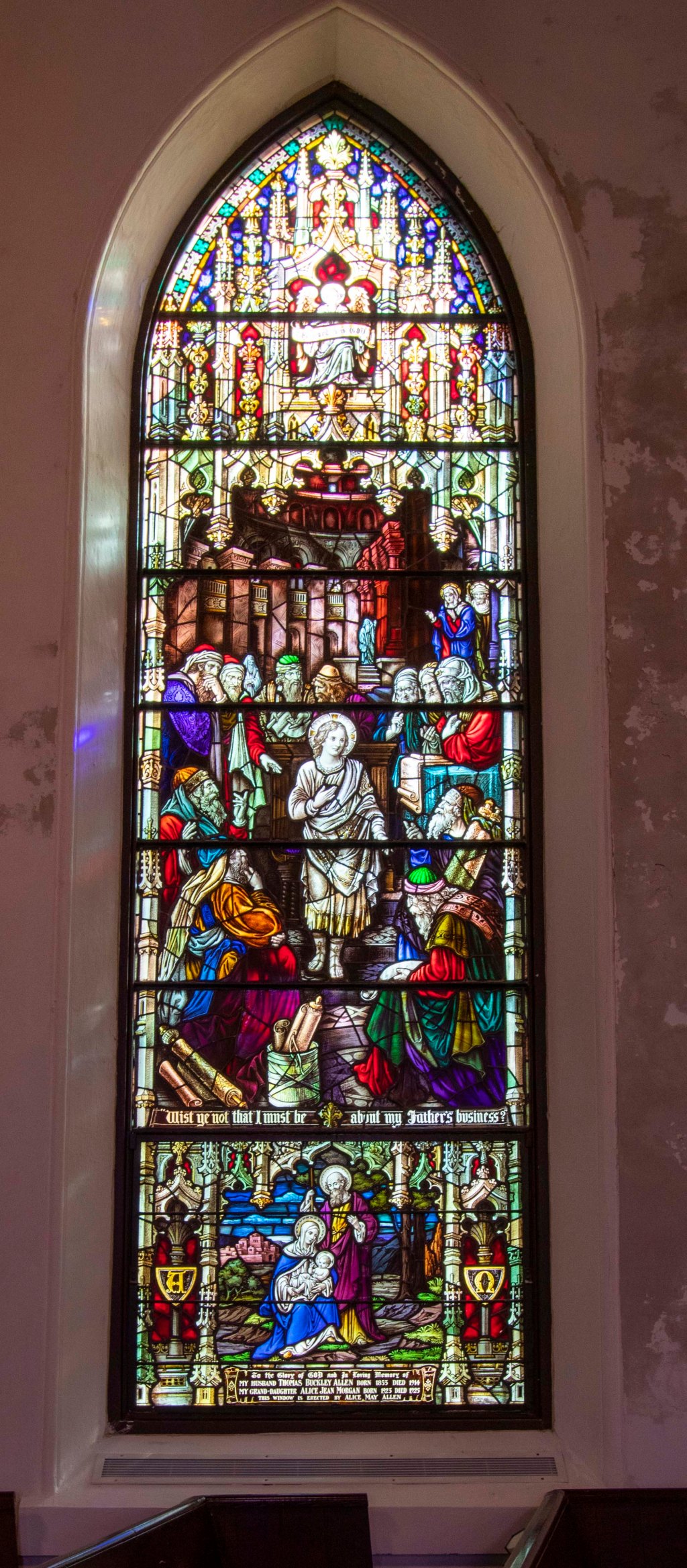
When Jesus was twelve years old, he went with his family to Jerusalem for a festival. As it was ending, his parents left but Jesus stayed behind. Like all parents who have lost their children at a supermarket or public park, his parents are overwhelmed with anxiety. But all’s well that ends well. Jesus was found in the Temple, sitting and asking questions of the teachers. “And all who heard him were amazed at his understanding and his answers” (Luke 2:47). “Why were you searching for me?” the precocious twelve year old Jesus says to his parents. “Did you not know that I must be in my Father’s house?” (Luke 2:49).
He was twelve years old. I was thinking back to what I was doing when I was twelve years old. First, I don’t think my parents would appreciate the sassiness. And second, at that age my main concerns were video games and trying not to get absolutely flattened at football practice. Because that’s who I was.
Because that’s who Jesus is. Jesus is about his Father’s business. This little snapshot, this little story we get from the Gospel of Luke sets up the rest of the story. We shouldn’t at all be surprised that when he grows up, Jesus will be doing pretty much the same thing he was doing when he was twelve. Teaching, talking, going about his Father’s business. And his parents come to realize, in a deeper way, just exactly who their son is.
This sounds about right, because at about that age, we start to realize who we are. Think back on your life, think back on the lives of your children. That age, it is a crucial age. It’s the age when we start realizing who we are. It’s when we start showing signs of what we will be, of what we’re interested in, of what we’re good at. You can tell stories about your children when they were this age.
So it makes sense that Jesus would be in the Temple, in his Father’s house, listening and asking questions when he was twelve. Because that’s when we start showing who we are. This is a coming of age story.
We do this with other popular figures, too. Who knows whether George Washington chopped down the cherry tree or not, and who knows whether he actually fessed up to it. That’s not the point. The point is that even as a young boy, he had character. There’s a similar legend about the Roman Emperor at the time of Jesus – his name was Augustus. Augustus was said to have given his first speech around this age, too.
So follow me here. That legend, that legend of the Roman Emperor giving a funeral speech, well, that was famous. Because it proved that even from a young age, Augustus was bound to be a great person; that he was bound to be Emperor. You can see what Luke is doing. Luke is taking that legend, the legend about the Emperor, and turning it back on the Romans. Luke was trying to show them that Jesus is better, smarter, more precocious even than the Emperor.
This is like watching the first century version of parents put “My Kid is on the Honor Roll” bumperstickers on their cars. The Gospel of Luke and the ancient Roman legends are each trying to prove who is better.
Don’t hear what I’m not saying. I’m not saying that this story about Jesus is made up. No. But I do think that Luke highlights it to make his point clear. That Jesus is worthier than the Roman Emperor. And if we’ve been paying attention, it’s the point that Luke is always trying to make. I asked all of you to read the Gospel of Luke at the end of last year, and I hope you’ve been doing that. Because you’ll see that Luke is challenging the Roman Empire.
Remember that line in the Gospel of Luke, remember what the angels said to the shepherd about the birth of Jesus? “I am bringing you good news of great joy for all the people; to you is born this day in the city of David a Savior, who is the Messiah, the Lord.” (Luke 2:10-11). Remember that? Want to know how the Roman high priest announced the birth of Augustus, the Emperor? He said, “The birthday of the god Augustus was the beginning of the good news for the world that came by reason of him” (Priene Calendar Inscription). Luke is directly refuting the Roman Empire’s propaganda machine.
I know that’s a lot of history, I know that’s a lot of background, but it all works together. You say that Augustus had a divine birth? No he didn’t, Jesus did. Augustus was a rising star as a kid? No he wasn’t, Jesus was. Luke is trying to convince those ancient Romans that it is okay to worship Jesus instead of the Emperor.
Because, here’s the catch, Jesus is not anything at all like the Emperor.
The Emperor goes out to conquer the world under the Roman Empire. Jesus goes out to overcome sin, loneliness, and death. The Emperor has armies and a navy and loyal followers. Jesus has a few friends from back home. The Emperor is vain, and has statues of himself placed all over the Roman Empire. To this day, no one really knows what Jesus looked like. And here is Luke, trying to convince those people in the ancient world, that is better to follow Jesus than the Emperor. It is better to follow the one who is crucified, than to follow the one who has the power to crucify.
From the very beginning, the Gospel of Luke is trying to break the mental hold that the Roman Emperor had on those ancient Romans.
As I suppose that I am, today. We come to church to break the mental hold that the powers of the world have over us. Out there, we’re bombarded by advertisements and propaganda and constant marketing. Out there, we are deceived into following people who seem to be powerful and authoritative, who seem to have all the right answers. We come to believe lies and half-truths and fake AI images, all because they seem to be true; all because we want them to be true. But you and I, we follow the one who is the Truth, though it is often uncomfortable. We follow a God who isn’t exactly powerful. Who isn’t really that popular. Who gets rejected. Who kind of has a weird family. Sound familiar? Yeah, he sounds like us.
And I think that’s the other thing that the Gospel of Luke is trying to do. We can see a bit of our story in the story of Jesus because we are all human. Jesus was born, not in a palace, but in a barn. As I suppose that most of us were born in pretty hum drum hospital rooms. Jesus showed who he was as a kid, as I bet a lot of us around that time got to know who we were. What Luke is trying to do is to show us that it’s worth following Jesus because Jesus knows what it is like to be us. To be human. To want things and to lose people and to have friends and to get betrayed and to be a kid and to be a teenager and to have good days and bad days and messed up families. It’s worth following Jesus because he is like us. The Emperor doesn’t care. The people making advertisements today, they don’t care about you. But we do care for each other, because Jesus does care for us. And that means that we can accept each other for who we are, not because of any of us are perfect, but because in our brokenness, we know what Jesus must have gone through. And more than that, Jesus welcomes people who also come from messed up families, who want things and who have lost people and have friends and get betrayed and have good days and bad days. Jesus welcomes me and you.
It’s a coming of age story. That even at the age of twelve, Jesus is teaching and amazing the people. But it’s also a sign, a glimpse into what he will become. He will become the One who challenges the powers of sin and death, he will become the One who reveals the powers of this world for what they really are. And Jesus will become the One who loves us and accepts us. Because he has lived as one of us.
Reference
Billings, Bradly S. “‘AT THE AGE OF 12’: THE BOY JESUS IN THE TEMPLE (LUKE 2:41-52), THE EMPEROR AUGUSTUS, AND THE SOCIAL SETTING OF THE THIRD GOSPEL.” The Journal of Theological Studies 60, no. 1 (April 1, 2009): 70–89.




 The Rev. Jimmy Abbott
Leave a comment