The Seventh Sunday after Epiphany
February 23, 2025
Luke 6:27-38
Jesus would have made a terrible banker. I mean, just listen to his advice: “If you lend to those from whom you hope to receive, what credit is that to you? Even sinners lend to sinners, to receive as much again” (Luke 6:34). It sounds like Jesus knows what he’s talking about, he’s using all the right banking and finance words: credit, lending, receive as much again. But imagine if Jesus proposed this kind of strategy down the street at Moody Bank or Frost, or even at our own church Finance Committee. “Thanks, Jesus, but we’ll take it from here.”
Why? Well, because, it’s not sound financial advice. We know that you should only loan to people who you know will pay you back, plus interest. And if you are going to loan money, you should screen them. You know, run a credit check, get references, put it down on paper, get witnesses; like that mountain of papers you have to sign when getting a mortgage. That’s how we operate. And then there is Jesus: “But love your enemies, do good, and lend, expecting nothing in return” (v. 35).
See money is his way of talking about love. It’s a metaphor, it’s an image, it’s a figure of speech. So, of course, Jesus uses money as an illustration. He does that because it’s something that we can wrap our minds around. Money is something we can touch, we can give and trade; we know the value of money. So, when Jesus is trying to get his point across about love, money is the most convenient way of doing so. Because money is real, and love feels so abstract.
Now, before I got any further, I want to talk about money in the ancient world. That’s going to help us figure out what Jesus means by love. First of all, we have lots more money than people did back then. I mean, there is just more wealth in general today than there was in the time of Jesus. And money is way more complex today than it was back then. There were no stock markets. You wouldn’t save money for retirement because, retirement wasn’t a thing. You weren’t saving for college, because college wasn’t a thing. You weren’t worried about your mortgage rate, because that wasn’t a thing. Money was simple back then.
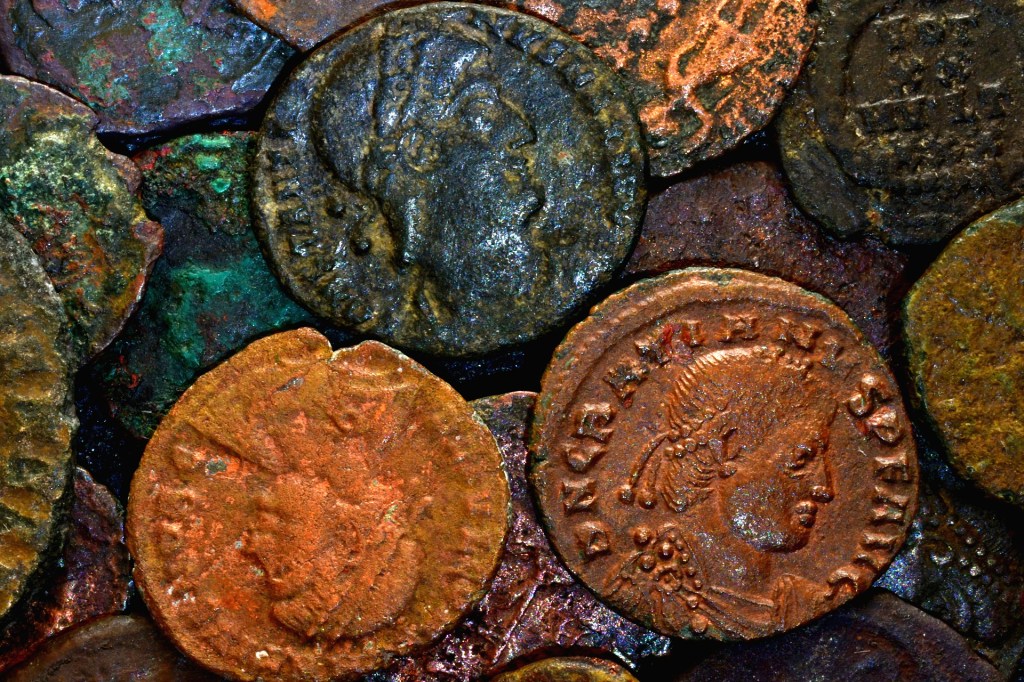
And finally, money was real, it was tactile. Today, money flies through the internet as little bits of information. I pay my bills online, I give my money to the church online; people even buy Girl Scout cookies with Venmo. I can see how much money I have in my bank account, but it’s just a number. In the ancient world, in the time of Jesus, money was something you held; something you counted, coin by coin; because it was precious, it was tangible.
So think about actually holding an ancient coin purse, feel the weight of that in your hands, and now listen to what Jesus says, “if you lend to those from whom you hope to receive what credit is that to you? Even sinners lend to receive as much again.” Think of that feeling. Of opening your coin purse, counting them up, and handing them over to someone else. Think of it – you would hear the sound of the coins clinking, you would feel the metal in your hands, you would have to touch the other person as you lent your money. You would have to look them in the eye. Your own money bag would feel physically lighter after you gave the money away. That is real.
And that, that is why Jesus uses money to talk about love. Because love, like money, has to be real. In today’s fake world, money is just numbers on a screen. And we treat love the same way. When we talk about loving our neighbors, when we talk about loving God, all too often it comes across as shallow, superficial. It has no weight. It’s all fake. This love, it has no spine anymore.
That’s what I hope to point out today. That Jesus uses money to talk about love so that we would feel the weight of it. And I believe that Jesus would be a good banker because he does know the real value of money. The real value of money is not what you can buy with it. Money is a sign of relationship. It’s a sign of value. Jesus says that we should lend and not expect anything in return. Because we ought to value the relationship between creditor and debtor, more than we value the finances of it.
So, take a look through your own spending habits; take a look at your own money. Open up that coin purse and start thinking through it. What do you value? If money is a sign of relationship, what relationships do you treasure? What relationships are worth opening that coin purse for, and pulling out those coins, and walking away lighter. I’ve said this often, you show me your bank account, you show me your credit card statement, and I’ll show you what your priorities in life are. That’s what Jesus is getting at. Money is real, it has value, and it will reveal to us what we really love.
What I’m doing today is asking you to think about the value of your money and to think about the value of your relationships. And when you give, and spend, and lend, I want you to consider the weight of it, the physical nature of loving God and loving neighbor.
As Jesus felt the weight of loving you. Jesus carried the hard wood of the cross. Jesus carried the weight of our scorn and shame. Jesus was weighed down by our hardness of heart. And that is precisely what makes his love so valuable. Because it cost something, it cost something real.
So flip that around – how can you express the weight of your gratitude to God, how can you show how much you love? Open up the purse that is your heart, feel the real weight of love, and give it away. This is what the people around us are craving. In this fake world, they want something real. Give it to them. Give them a love which costs you something. Feel it.
And the difference between money and love is this. There is only so much money to give and to lend. That’s obvious. The more you give away, the lighter your own purse gets. Not so with love. The more you give, the more you receive. So check yourself today. If you are looking for more love in your life, do not try to accumulate it. Work on giving away whatever love you have. And it will come back to you. As the love Jesus gave on the cross came back to all of us. “The measure you give will be the measure you get back” (Luke 6:38b).
And today, I’m going to end with that amazing prayer we started with. It says everything I want to say this morning. Let us pray. “O Lord, you have taught us that without love whatever we do is worth nothing: Send your Holy Spirit and pour into our hearts your greatest gift, which is love, the true bond of peace and of all virtue, without which whoever lives is accounted dead before you. Grant this for the sake of your only Son Jesus Christ, who lives and reigns with you and the Holy Spirit, one God, now and for ever. Amen” (Book of Common Prayer, 216).



 The Rev. Jimmy Abbott
Leave a comment