
April 18, 2025
John 18:1-19:42
This long lesson we just read, it is the heart of our Christian faith. Jesus is betrayed, arrested, interrogated, tortured, executed, and buried. All for our sakes’. And so we gather today to render thanks for his great gift – the gift of himself.
And yet, Jesus is not the only character in the story. There’s Judas, the priests and police in the garden. There’s Peter and the servant girl and some accusers around the charcoal fire. There’s Pontius Pilate, and the crowd, and the soldiers who crucify him. There are the women – Jesus’ mother the Virgin Mary, his mother’s sister, Mary the wife of Clopas, Mary Magdalene. It’s almost like you need a Playbill to keep track of everyone coming and going.
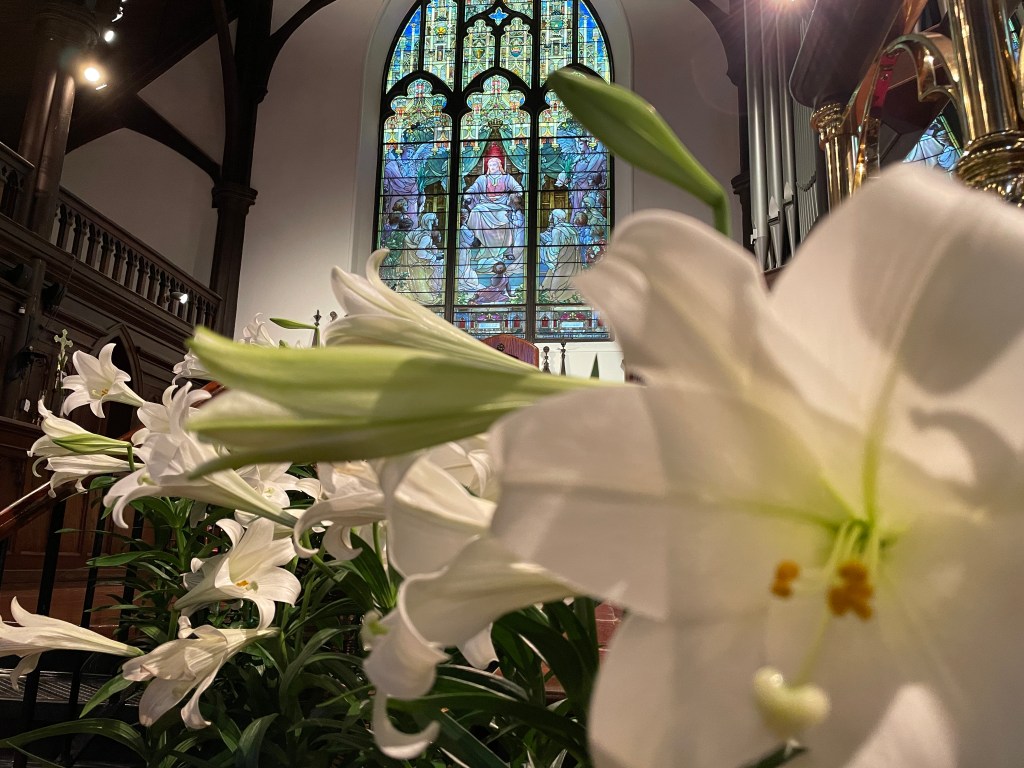
And then there is one final character. Joseph of Arimathea. The one who buries the body of Jesus at the end. There are lots of legends about Joseph of Arimathea. That he took the cup that Jesus used during the last supper and then collected the blood dripping from Jesus on the cross in that same cup. That’s the “Holy Grail.” If you look over there, at our Crucifixion window, you can see it. That’s why there is a cup floating there above the cross. The legend goes on; that Joseph of Arimathea travels all the way to Britain with that cup, and that he is the first Christian in England. That’s where King Arthur legends about Sir Galahad and Sir Lancelot come from; they are seeking out the Holy Grail that had been brought to England by Joseph of Arimathea.
But those are legends. Inhabiting the fuzzy borderlands between history and myth. The actual account of Joseph of Arimathea is actually quite scant.
The story we just read from the Gospel of John says, that after Jesus died on the cross, “Joseph of Arimathea, who was a disciple, though a secret one because of his fear of the Jews, asked. Pilate to let him take away the body of Jesus. Pilate gave him permission; so he came and removed his body” (John 19:38). Then, along with Nicodemus, who had at first come to Jesus by night all those years ago early in his ministry, Joseph of Arimathea lays the body of Jesus in a tomb (John 19:38-42). And that’s it. That’s the whole story about him.
Joseph, like most of us, was a timid disciple. Surely, there was a lot running through his head and his heart in that moment. He had just watched his Lord suffer and die. He had watched the leaders in Jerusalem whip up the crowd against Jesus. He had seen how they paid fealty to the Roman Emperor. Joseph had seen both how feckless and how cruel Pilate could be. Surely, Joseph must have also feared for his own life, if it became too widely known that he, too, was a follower of the crucified man. Perhaps, he would be given the same fate. But, Joseph could not bear to see Jesus’ body hang on the cross any longer – eaten by the birds and the dogs. For, that was what usually happened to those who had been crucified.
So Joseph “plucks up his courage.” Perhaps Joseph should be the patron saint of cowards. As living proof that courage can overcome fear. Knowing what it might cost him he asks for the body of Jesus. Knowing that it might mean his own death sentence, knowing that it might mean the people of Jerusalem cut him off. Pilate – just wanting to be done with the whole affair – is more than happy to let Joseph do what he wishes with the body of Jesus.
And then what Joseph does, causes me to tremble. He takes the nails out of Jesus’ body that were driven into the wood of the cross. That would have been grisly work. He would have needed a ladder, and a hammer. And then he would have to hold the body of Jesus and lower him down, which by then would have been a bloody mess. Imagine what Joseph would have looked like after doing that. For Joseph, there would be no hiding from his neighbors what he had just done.
Surely, more than anyone in all of Christian history – Joseph of Arimathea knows what it means that Jesus’ blood was shed for his sake. For he would have been covered in that blood.
The Gospel of Matthew tells us that the tomb Joseph used for the body of Jesus, was his own (Matthew 27:60). Surely, more than anyone in all of Christianity – Joseph of Arimathea knows what it means that Jesus died for him. For he would have seen the body of Jesus where his own body should be.
The grand legends about Joseph of Arimathea are interesting, but actually they pale in comparison to what little we know. For we know a man, like us, was afraid. But through his fear, he does more than I could imagine.
This is a call and a reminder, for all of us timid disciples. Like me. That the magnitude of our fears will be met with the magnitude of God’s grace. Joseph, a follower of Jesus, though a secret one because of his fears, is given grace and insight that we cannot imagine – simply because he had the courage to do the right thing when the moment pressed upon him.
I don’t know what that moment will be for me, or for you. But it is bound to come. So when you are standing at the foot of the cross – torn by decision, torn by the crisis between faith and fear – think back to that one minor character. Pluck up your courage for Jesus.
See also
Martín, Michael Angel. “For Joseph of Arimathea.” Anglican Theological Review 100, no. 2 (December 31, 2018): 379–379.
Temple, William. Readings in St. John’s Gospel

 The Rev. Jimmy Abbott
Leave a comment