
Fourth Sunday after the Epiphany
February 1, 2026
1 Corinthians 1:18-31
The hardest sermons to write, I’ve found, are always those that happen in the aftermath, in the shadow, of some national news event. We all come to church, with those stories, those images, those ideas, in our minds, whether we want it that way or not. Especially when it comes to highly politicized issues, some people expect me to say something about it; some people want me to avoid it. And sometimes I choose to say something; sometimes I don’t. That is rarely a value statement on whatever it is that has happened; but more a reflection of where the Holy Spirit is leading me that week and how I feel. Sometimes things have been too raw for me, personally, to speak about; sometimes I do manage to find the words. So, with humility, I offer these words now.
As I think about all that has happened in our society, the first thing I want to say, is that I have purposefully avoided watching any videos, or seeing any pictures, with violence. I just can’t stomach it. And, I am concerned that I could become desensitized to human suffering and to human cruelty. As a Christian, I should hold every human soul tenderly. Each of these events should be an occasion for me to drop to my knees, begging mercy of the Lord God Almighty – mercy upon us, mercy upon me. I just cannot look because I’m scared of what I would become.
I confess, this is how I feel six days a week, broken and fearful man that I am.
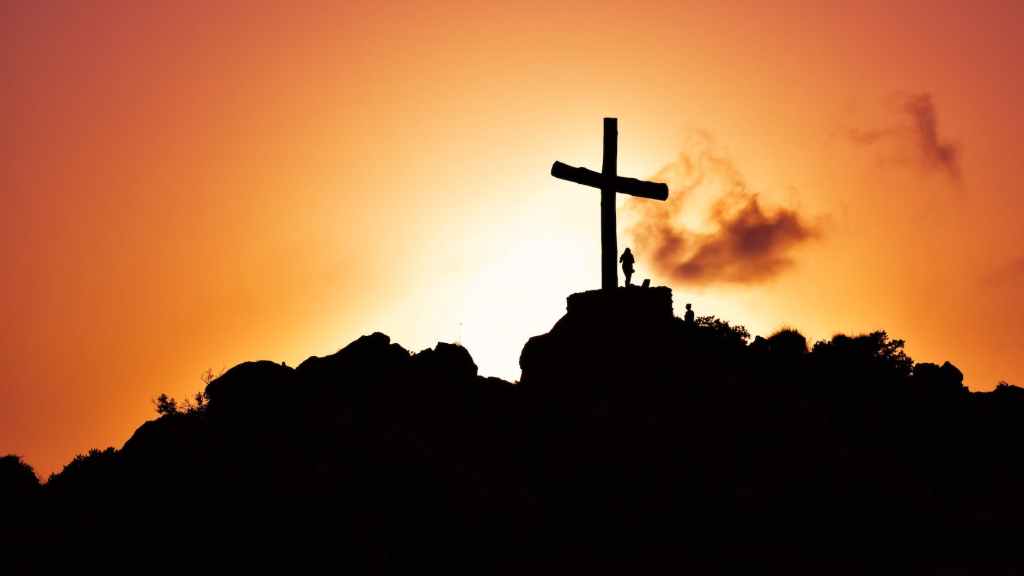
And then on this day, the Lord’s day, I’m confronted by something I cannot escape. That cross. I process into church and my eyes are captivated by that cross, that sign of both my salvation and my judgment. And unlike all those videos that I can choose to watch or not, I cannot escape from this one. I have to look. And I cannot help but see our Lord Jesus, with arms outstretched. As he hangs there, dying for me and dying for you. And it’s then, it’s then that I realize I don’t just preach in the aftermath of some events of our time. Every sermon, every deed of the Church, everything we do as Christians, is done in the aftermath of the cross, in the shadow of the crucifixion.
And the violence that Jesus underwent holds me transfixed, and it’s these words, these blessed words from Saint Paul that I hear, these words that we read this morning: “For Jews demand signs and Greeks desire wisdom, but we proclaim Christ crucified” (I Corinthians 1:22-23). See, Saint Paul is cutting across the divides of his day. For the ancient Jews, they were looking for signs of God’s presence; they were looking for a manifestation, for miracles. For the ancient Greeks, they sought philosophy, new ways to think about the world, they sought insight. But of course, Jesus will not be defined by human categories. The world couldn’t control him, so he suffered the great injustice. And that is what we proclaim – Christ crucified.
And it seems that Saint Paul is speaking to us, even now. Just as today everybody comes to Jesus, looking to bolster their own opinion. Like Jews demanding signs, and Greeks desiring wisdom, we all want something from Jesus. We all want him to agree with us. Then we make demands of each other, we all have our desires for wisdom and power; and yet Christ humbles each of us, by stretching out his arms on the cross. By receiving that violence, he takes every act of brutality, every inconsiderate deed, every death upon himself. Jesus is the victim.
Which bring us back to today; in the aftermath of what we have all been seeing. I have no public policy ideas; I do not know how to work ourselves out of these intractable political situations. But what I do know, is the message of the cross. By seeing his blood, we are not desensitized – we ought to be re-sensitized to every human agony. And I know that this message still has power today to make a difference, to change the world, to change lives.
We should see it, in ourselves and in all these women and girls making vows for the Daughters of the King. Consider your own call, sisters: “not many of you were wise by human standards, not many were powerful, not many were of noble birth.” But “God chose what is foolish in the world to shame the wise; God chose what is weak in the world to shame the strong; God chose what is low and despised in the world, things that are not, to reduce to nothing things that are, so that no one might boast in the presence of God” (I Corinthians 1:26-39). That is what we hope from you. That by clinging to the cross, by thinking about every human problem through the lens of the cross, you would make a holy difference in your life, in this community, and in the world. And it may feel that the problems are too large, the conflicts too calcified for you to do anything about them. You are only one, but you are one. One who can make a difference, by proclaiming Christ, and him crucified.
And part of that proclamation, I believe, is to lament. To lament the fact that we have all, in our own ways, rejected Jesus. To lament the fact that we humans are given to such cruelty. To lament the fact that all of us, in our own ways, have justified some such violence. It is time for us, I believe, to lament of how callous we have all become. Or, maybe that is just me. Then it is time to turn my eyes back to the cross of Christ. That, that should be my first thought seven days a week.
This is the role of the Church, in modern society and in any society. To speak differently, to think differently, to be salt and light. To turn our gaze back to the cross so that our hearts would be softened to God and to each other. Because there, on the cross, we see Jesus with arms outstretched, pulling back together again God and humanity. This is our call, this is our purpose, this is what the Church is to do in every age. With arms upon the cross, to love God and to love neighbor. This may seem like some childish, immature version of Christianity, unfit to contend with the realities of this brutish world. But as Saint Paul says, “The message about the cross is foolishness to those who are perishing, but to us who are being saved it is the power of God” (I Corinthians 1:18).
Don’t hear what I’m not saying. I’m not saying that there should be no accountability. I’m not saying that love is a soft thing. Love is worth dying for. Love is defined by the hard wood of the cross. And justice? I mean, shouldn’t we find it captivating that the ultimate symbol of our faith, is one of injustice? So that when we do feel, see, live through an injustice, we can trust, somehow, that God is with us.
Finally, I have offered these words in light of national and international events. Some will think I have said too much, some will think I have said too little. Be that as it may, the Holy Spirit and I have struggled mightily with this sermon over these past two weeks. And, it’s not just been national or international events on my mind. These words are also offered in the shadow, in the aftermath, of a decision in a courtroom here in Galveston just on Friday. A situation, a decision that pains me, and pains so many of us. Powerless that I am, all I can do is to lament, to cling to the cross of Christ, to weep for the life that was taken away and for all the lives that are forever changed. And pray that I never become desensitized to such horrors. So in times of such agony, such confusion, such turmoil – both here locally and everywhere, all I can do is share again the words of the one who suffered for us:
“Blessed are the poor in spirit, for theirs is the kingdom of heaven.
“Blessed are those who mourn, for they will be comforted.
“Blessed are the meek, for they will inherit the earth.
“Blessed are those who hunger and thirst for righteousness, for they will be filled.
“Blessed are the merciful, for they will receive mercy.
“Blessed are the pure in heart, for they will see God.
“Blessed are the peacemakers, for they will be called children of God.
“Blessed are those who are persecuted for righteousness’ sake, for theirs is the kingdom of heaven.
“Blessed are you when people revile you and persecute you and utter all kinds of evil against you falsely on my account. Rejoice and be glad, for your reward is great in heaven, for in the same way they persecuted the prophets who were before you” (Matthew 5:3-11).



 The Rev. Jimmy Abbott
Leave a comment