Good Friday
April 3, 2026
John 18:1-19:42
Good Friday. Today we are gathered here to commemorate the pivotal, historical moment of our faith. When the Lord Jesus was betrayed, condemned, and crucified. Long has this day been a day of prayer and fasting for Christians. For two two thousand years, we have gathered to lament, to confess our sins, to recall the excruciating horror that Jesus underwent. And we pray in thanksgiving for this great act by which we are reconciled to God. As Jesus stretches out one arm to us, and one arm to his Father; bringing us back together. Through the cross of Good Friday.
Tragically, though, in the course of Christian history, Good Friday has also been known for something else. As the priest and theologian Lauren Winner details, it has often been Holy Week, and Good Friday specifically, that mobilized Christian violence against Jews. This is simply part of the historical record, and one of the darks blights upon the history of our faith. Motivated by this gospel lesson we just heard and the prayers of Good Friday, some Christians would accuse their Jewish neighbors of being responsible for the crucifixion of Jesus. Some Christians were known to physically attack Jewish people during Holy Week, partly in retribution for killing Christ. Was this motivated sheerly by religion? Most likely not. There was clearly fear of others. There were economic anxieties. And sometimes, Jewish people were simply a convenient scapegoat for social ills. Especially in the medieval church, this was the mixture – religious, social, and economic – that precipitated violence against Jews during Holy Week and on Good Friday.1
It is one of the great sinful ironies of the Church – that on the day the Lord Jesus received violence, Christians committed violence in his name. I wish it were not so, but it is part of where we come from.
Of course, obviously, this is not all Christians. And as we often like to say, Galveston itself is just a bit different. Blessedly, Christian people and Jewish people have lived here side by side, working together with mutual respect. Specifically, the people of Trinity Church and the people of Congregation B’nai Israel have a long, and storied friendship. We thank God for this great gift.
In that vein, there are a few changes that have been made to this Good Friday service. These changes, have been offered, by the wider Episcopal Church, to better reflect our shared ancestry of faith with Jewish people. And these changes have been made to offer a better historical context for those last hours of Jesus’ life.
So I’ll start there. In the passion gospel that we just read, the Greek word Ἰουδαίων is translated as “Judean” rather than “Jew.” Think of this way – in geometry, a square is a rectangle, but a rectangle isn’t a square. In this context, every Judean would have been a Jew, but not every Jew would have been a Judean. This also recognizes that religious Judaism in the first century was not one thing – there were a variety of sects, groups, ideologies that would have all called themselves “Jewish.”
So, in years past, we would have heard that Jesus is mocked as the “King of the Jews,” and that it was the “Jews” who condemned Jesus. While it is true that those people were Jewish, there is a political context missing there. The Judean leaders are also political and social leaders, not simply religious leaders. And that’s important in this story – Jesus represents a challenge to the Judean leaders, because the Judean leaders don’t want the Romans to think there’s anybody else claiming to be king, other than the Roman Emperor. That’s why the Judean leaders are anxious to have Jesus crucified. The Judean leaders want to make sure the Romans know that Caesar is in charge, not Jesus. Yes, religion is at play, but so are politics. That seems to get closer to the historical reason for the crucifixion.
So, in this new translation, Jesus is mocked as “King of the Judeans.” It is the “Judean leaders” who whip up the crowd against Jesus, and not “the Jews.” Though it’s not a perfect translation of the original Greek, because there is no perfect translation, it helps communicate a subtle, but important difference. The people responsible for handing Jesus over to be crucified were those specific leaders in Jerusalem; and not all Jews for all time. Just as you and I not responsible for anti-Jewish violence in the medieval world, our Jewish friends today are not responsible for the crucifixion of Jesus. This language helps us distinguish those things. The only place where “Jewish” is retained in the story we just heard, is when the story refers specifically to the religious burial practices of first century Judaism. Again, subtle, but important.
The second change, is a prayer that we will offer in just a few moments. It is a prayer that specifically recognizes our shared spiritual heritage with Jewish people. So, rather than stirring up animosity against the Jewish community on Good Friday, as has happened in the past, this is meant to soften hearts. For us, specifically here in Galveston, it’s a prayer that acknowledges what we already feel and know. That we are neighbors.
And I can say, that these changes have already made things easier. Just this week, I sat down with Rabbi Peter Kessler to talk through Good Friday, and what it means for Jews and for Christians. And again, the word usage, these prayers – it just helps. It helped both of us talk through the complexities of our faiths, and of our shared histories.
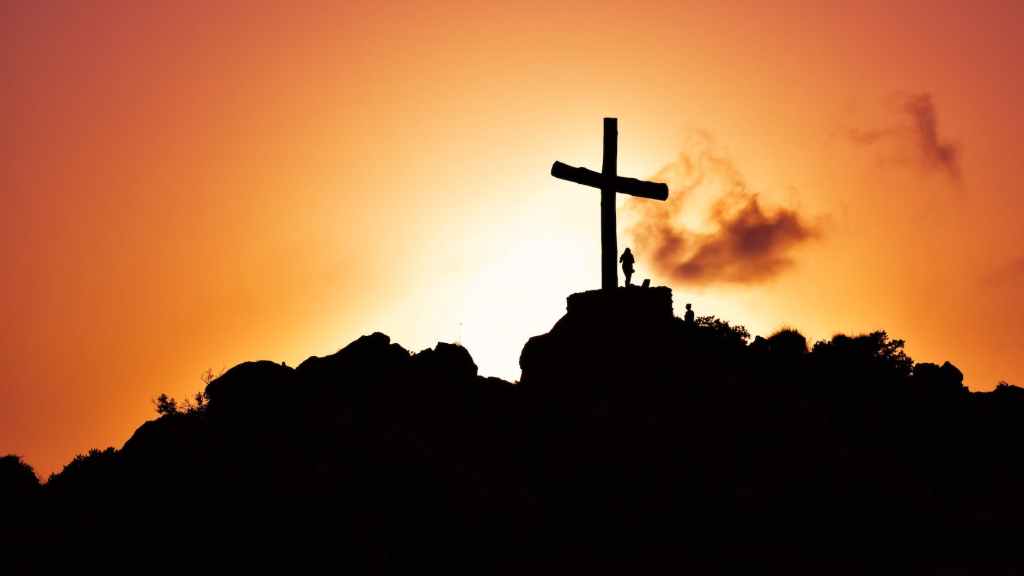
The worst of Good Friday is when Christians go outward, in a perverse desire to take revenge. The best of Good Friday sends us inward, in humility. To reflect on our own sins, to seek God’s forgiveness, to make amends. To ponder this great love that Jesus has – that he would dare to offer himself upon the cross for us. And perhaps, that is the real scandal of the cross. It stands not as a sign of condemnation – on Jewish people or on Christians, or on anybody. The instrument of shameful death has been transformed. Now the cross stands as a beacon of hope. So that what was once shameful would now become light to the world. Good Friday shows us how to live, how to love, like Jesus, stretching out our arms on the hard wood of the cross, not in anger, but to embrace our neighbors.
- The Dangers of Christian Practice, Lauren Winner, 33. ↩︎



 The Rev. Jimmy Abbott
Leave a comment