Twelfth Sunday after Pentecost
August 16, 2026
Matthew 15:21-28
There were the fresh haircuts. The new backpacks. And all the nerves for the first day of school. This was my sixth year to watch the first day of school here at Trinity. And I would imagine it’s like this at every school on the first day. Teachers wondering what all their new students will be like. Students wondering if they have any friends in their classes. New kindergarteners walk into this big building, with all sorts of other big kids. Some of the parents get a little teary dropping their kids off for the first time. Some of the kids are a little, shall we say, reluctant? And some of the kids can’t get out of the car fast enough.
I think there’s all that excitement, all those nerves because, for everyone, it’s a new beginning. It really is the most amazing thing – that even though we do this thing every year, every year we go through all the same stuff for a new beginning.
A new beginning. It’s what that woman, that nameless woman, wanted. You just heard the story – this woman, this faithful woman, is desperate. Her daughter is in bad shape. Imagine the worry, the angst, the sleepless nights this woman had spent concerned about her daughter being tormed by a demon. Two thousand years on, we’re not quite sure what that means. It could be a demon, it could be mental illness, it could be any number of things. But what matters, what matters is that woman is desperate for a new beginning. She wants healing for her daughter, so that her daughter can have a fresh start in life.
But what’s shocking, is that she would ask Jesus for it. This woman was a Canaanite, and Jesus was a Jew, obviously. But Canaanites and Jews were not on friendly terms. The people from Tyre and Sidon, where this woman was from, and the people of Galilee, where Jesus is from, are cultural, religious, and economic rivals. There’s bad blood. If you remember your Old Testament, when Joshua led the people of God into the promised land, they fought a war against the Canaanites. In the time of Jesus, Tyre and Sidon were economic powerhouses, great port cities that shipped grain all over the ancient world; Galilee was a poor, rural, agricultural backwater. They grew the grain that the people of Tyre and Sidon made money off of. The people of Tyre and Sidon thought that the people of Galiee were country bumpkins. Dirt farmers. You know all those same issues we have today – about people who lives in cities and people who live in the country? It was the same back then. So the very fact that this city dwelling, non-Jewish woman, would ask a Jewish rabbi from the sticks for help, is shocking.
But that’s how desperate she is. That’s how desperate she is to help her daughter. She is willing to give up her own ego, her pride, her respectability, her ethnicity – just to have a chance at a new beginning.
It’s also a new beginning for Jesus. Now, you can sense Jesus’ anger. He’s aware of all those issues between Canaanites and Jews. He knows about the centuries of conflict and oppression and heartache. He knows what those Canaanites think of the Jews. You can hear the pain in his voice, and the way he speaks to this woman. But this moment, for him, also represents a new beginning. A new beginning of who is going to be part of this Kingdom of God. Notice – he says that he was only sent to the lost sheep of the house of Israel. And then, he commends this woman for her faith. The subtlety here is critical. Jesus does not say – well there are the people of Israel, who are God’s people, and then all these other folks that we tack on. No, in a way, Jesus is saying that this Canaanite woman, this woman who was not a Jew, this woman who represents the enemies of Israel, is now part of Israel. Part of God’s people, through her faith. Through her faith, she has become part of God’s people. Again, this is huge. Jesus is not making two families of God. One that is for the Jews and one that is for everyone else. No, there is one family of God, regardless of all the past animosities and hatreds. This woman, a Canaanite, is as much a member of God’s family, as the bona fide Jews, through her faith.
It’s a new beginning. A new beginning that launches what we now call, The Church. The Church of Jesus Christ, is not defined by ethnicity, or heritage, or ancestry, or language, or respectability, or identity, or any of the things that we humans get so wound up about – the Church of Jesus Christ, what are we doing right now, is defined only by faith. Our shared faith in Christ, and God’s faithfulness to us.
That’s the new beginning that Jesus launches. That all the old distinctions, the distinctions that the world continues to hang onto, are washed away in baptism. In the Church, the only defining characteristic is faith. Just like this nameless, faithful woman. The Church of Jesus Christ does not care where you come from, or how long you’ve been here – it’s faithfulness. Canaanites and Jews. Men and women. Anyone who comes looking to Jesus. From that little kindergartner to the person that’s been here forever – everyone belongs through faith. That’s the new beginning. And this is the good news of Jesus Christ. Every person, every person is welcome to be part of this movement, this body, the Church, through faith. Whatever your background, whatever you have done or not left undone, everybody, everybody can have a new beginning through faith. And not just once, but every time we return to Christ in faith.
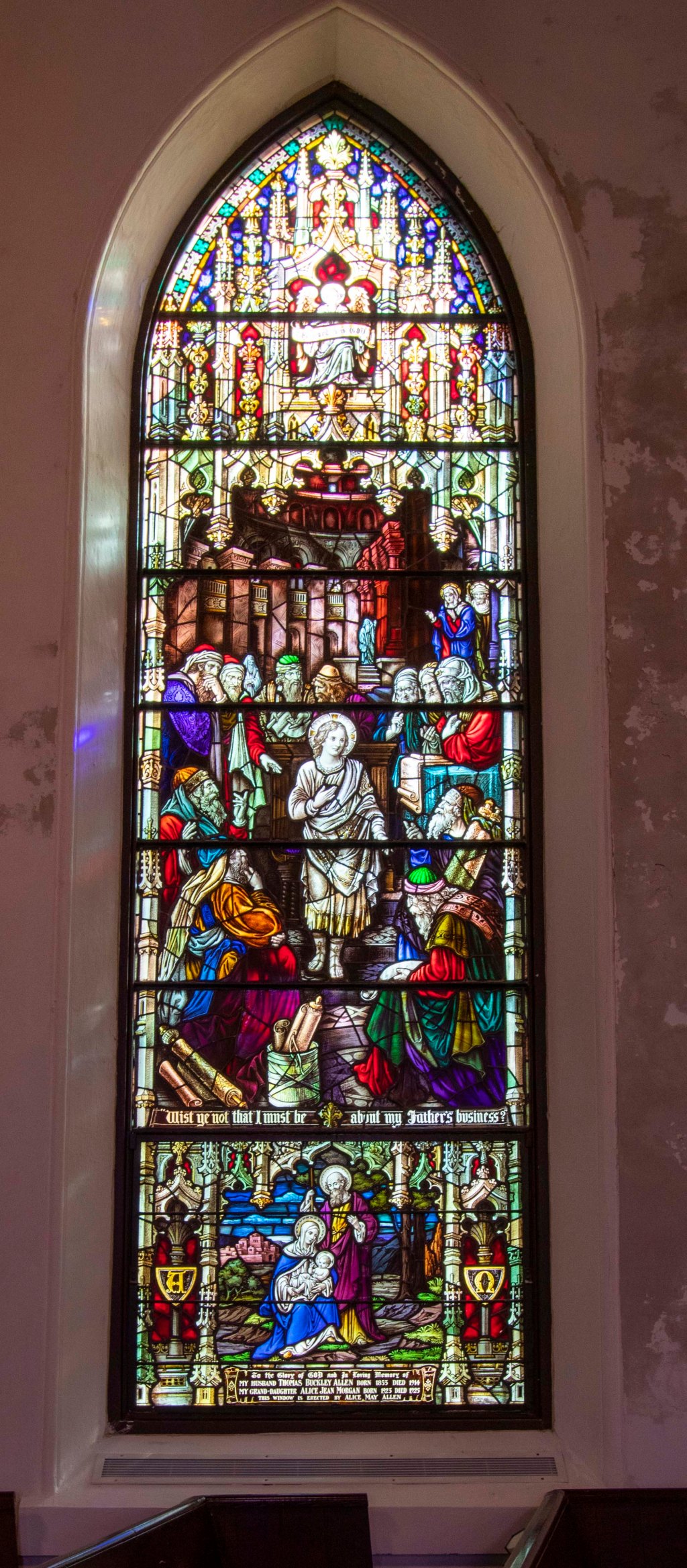
And so it has been for two thousand years. The Church has always been about new beginnings. Even this place. All those windows are back, thank goodness. And thanks to you, and your generosity. But it’s not about the windows, it’s a sign of what is going on in our souls. That things which have fallen apart can be made new again. Things which had grown dim can shine again. Just like your soul and mine – a new beginning, through faith.
I suppose the next natural question is, “how do I get that faith?” Well, that’s the mystery. Faith cannot be earned, it cannot be purchased. It seems it’s more of an attitude, a way to look at the world. Faith doesn’t always make intellectual sense, because it’s a matter of the heart. And I’ll say, that in my experience, the most profound faith often comes from the people most like this nameless woman who just wanted her daughter to be well. The most faithful people I’ve met are not in it for themselves. It’s the people who care for their neighbor who’s having a tough time. It’s the people who reach out when someone is lonely. It’s the people who want to make our whole community better, happier, holier. So perhaps the clearest way to know if it’s faith or not, is to ask who it benefits. That nameless, Canaanite woman wasn’t in it for herself, and yet it’s her faith that is commended. Because the benefit was for someone else.
In the same way, God is faithful to us, not because it benefits him, but because it benefits us. God’s faithfulness to us – his abiding love, his abounding mercy, his willingness to put up with our sins and bless us anyways – that’s the faithfulness of God. That’s how faith works. As we begin this new school year, as we begin this new chapter in our church, I pray most fervently for that we would be faithful. Not so that we are better from it, but so that this town, this community, this world would come to know the grace of God – so that everyone could have this new beginning.





Leave a Reply